


Tel: +86-131-8042-1118
E-mail:
E-mail:
26 Huanghai Road, Leting Economic Development Zone, Hebei Province, China


Views: 0 Author: Site Editor Publish Time: 2026-07-31 Origin: Site


Inefficient scaffolding erection compounds project costs rapidly. Labor overruns, site downtime, and failure to meet strict safety tolerances plague modern industrial and commercial construction sites. Traditional tube-and-clamp setups and inferior modular systems often fall short. They suffer from geometric inflexibility, lower load capacities, and a high dependency on skilled manual labor to achieve basic structural integrity.
To solve these site challenges, contractors turn to engineered modular solutions. The Ringlock Scaffolding System stands as the industry standard. This article provides a technical evaluation of its engineering, component architecture, and long-term viability for site managers. We will examine how this specific system scaffolding addresses complex geometries while significantly reducing erection times and improving overall site safety.
Engineered for Speed and Geometry: The central rosette node allows up to eight connections at various angles, drastically reducing erection and dismantling times compared to traditional methods.
Superior Load Capacity: Manufactured from high-tensile galvanized steel (typically Q345/Q355 grade), Ringlock supports heavy-duty industrial applications, shoring, and complex suspended structures.
Labor vs. CapEx Trade-off: While initial procurement costs are higher, the standardized components of this system scaffolding reduce labor hours by up to 30-50%, accelerating project timelines and improving ROI.
Strict Compliance: Pre-engineered nodal connections eliminate the guesswork of manual clamp tightening, ensuring consistent compliance with OSHA, EN 12810/12811, and other global safety standards.
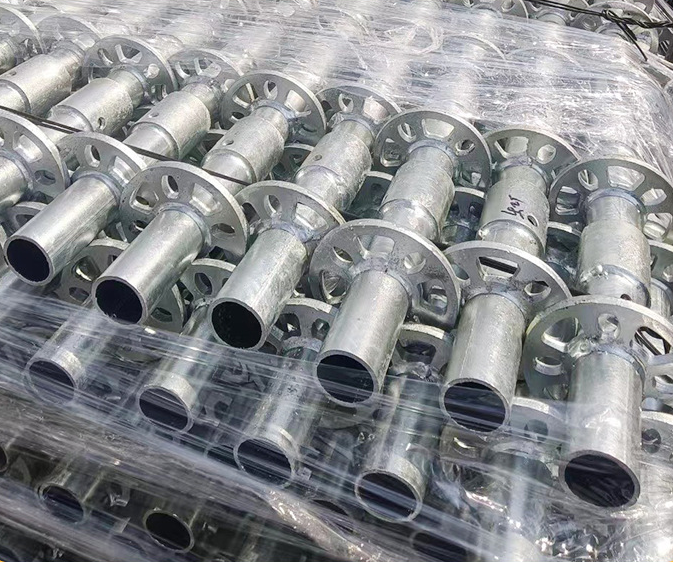
The Ringlock design is a modular, multi-directional framework utilizing a precise wedge-lock connection mechanism. Unlike older methods requiring constant manual measurement and leveling, this system relies on fixed connection points to dictate structural geometry. You build it by connecting horizontal and diagonal members to vertical posts at set intervals. This creates a rigid, load-bearing structure suitable for access or shoring.
The core engineering advantage lies in the rosette. Welded to vertical standards at precise 500mm intervals, these rosettes allow for multi-directional, wedge-locked connections. Crews secure horizontal and diagonal members without loose fittings. The rosette features eight holes. Four small holes accommodate rigid 90-degree angles. Four larger holes allow for self-aligning transitional angles. This eliminates the need for manual squaring during assembly. When a scaffolder strikes the wedge with a hammer, the connection locks tight. The geometry forces the ledger head against the standard, creating a highly stable joint.
Legacy tube-and-fitting methods require extensive manual load calculations. They rely heavily on the individual skill of the scaffolder to tighten clamps to the correct torque. Ringlock shifts this burden from the site worker to the manufacturing facility. Pre-engineered safety tolerances mean that if the wedge is driven home, the connection meets its designed load capacity. This modular approach drastically reduces human error. You do not need to measure the distance between lifts. The rosettes dictate the spacing. This speeds up the build and ensures compliance with fall protection regulations.
Industrial environments demand robust materials. Ringlock components are manufactured using High-Tensile Q345B or Q355 steel. This steel grade offers a high yield strength, allowing the system to support massive loads without buckling. To combat harsh weather, chemical exposure, and offshore salt spray, the steel undergoes Hot-Dip Galvanization. A minimum zinc coating thickness of 60 to 80 microns protects both the internal and external surfaces of the tubes. This prevents structural degradation and extends the asset's working life. Paint or powder coating chips easily on a construction site. Galvanization bonds with the steel, providing superior long-term protection.
A complete setup relies on a standardized set of interlocking parts. Understanding these components is essential for accurate inventory management and safe site deployment. Each piece serves a specific structural purpose.
Standards act as the load-bearing columns of the structure. They transfer the weight of the platform, workers, and materials down to the ground. They are typically manufactured with a 48.3mm outer diameter and a wall thickness of 3.2mm or 4.0mm, depending on the required load class. The integrated rosette rings allow crews to build vertically while maintaining exact 500mm lift heights for subsequent horizontal connections. Standards come in various lengths, usually ranging from 0.5m to 3.0m. You connect them end-to-end using integrated spigots.
The Ringlock Ledger functions as the horizontal connecting member. It provides lateral support and acts as a guardrail. The cast steel ledger head features an integrated wedge that slides into the rosette hole. A simple hammer strike locks it into place, forming a rigid 90-degree angle. Standard lengths include 0.73m, 1.09m, 1.40m, 1.57m, 2.07m, 2.57m, and 3.07m. This allows contractors to standardize bay sizes across different projects. Ledgers also support the steel planks that form the working platform.
Diagonal bracing provides torsional rigidity. It prevents structural sway under heavy wind loads or dynamic site activity. The braces feature a pivot-pin end-connector design that easily aligns with the larger holes on the rosette. This locks the vertical and horizontal planes into a stable triangle. Without diagonal braces, a scaffold can collapse under lateral forces. You typically install them on the outer face of the scaffold, following a specific pattern dictated by the engineering design.
Every stable structure requires a solid foundation. Adjustable screw jacks level the system on uneven terrain. They safely transfer structural loads to the ground. Base collars sit over the screw jacks. They provide the initial rosette connection point to begin the ground-level ledger framework. The screw jack allows for fine adjustments, ensuring the entire structure remains perfectly plumb. You must place them on adequate sole boards to distribute the load over the ground surface.
Non-slip, interlocking steel platforms create safe working areas. These planks feature integrated wind locks that secure them to the ledgers. Beyond providing a walking surface, locked steel decks contribute significantly to the overall horizontal stability of the scaffolding bay. They prevent the ledgers from bowing inward under load. Steel planks are far superior to timber boards. They do not rot, warp, or catch fire. They also provide a consistent, predictable load capacity.
Complex sites require specialized access. System accessories expand the capabilities of the basic components. You can add stair towers for safe vertical transit. Bracket extensions allow you to work beyond the main scaffold footprint. Lattice girders bridge large structural gaps where ground support is impossible. Other accessories include loading bays, debris netting attachments, and specialized lifting hoists.
Contractors must evaluate scaffolding based on hard performance metrics. Ringlock consistently outperforms older modular types across several key engineering dimensions. It offers a superior combination of strength, speed, and adaptability.
Ringlock easily achieves Class 4 to Class 6 load ratings. The concentric loading of the rosette connection maximizes shear strength and axial load transfer. Vertical stress distributes evenly through the standard rather than relying on the friction of a clamp. This maintains structural integrity under heavy masonry or industrial shoring applications. The high-tensile steel construction further enhances the load-bearing capabilities. You can safely support heavy equipment, bulk materials, and large crews.
Time is a critical site metric. The hammer-strike wedge lock system offers significant time-motion benefits. Crews spend less time measuring and tightening. Industry benchmarks show that this standardized approach can reduce labor hours by up to 50% on complex builds compared to traditional tube-and-fitting methods. Dismantling is equally fast. A quick strike to the bottom of the wedge releases the connection. This rapid turnaround minimizes site disruption and accelerates the overall project schedule.
Industrial sites rarely feature simple straight walls. The combination of small and large holes on the rosette allows for both 45-degree and 90-degree connections. This flexibility makes the system ideal for wrapping circular tanks, navigating curved architectural facades, accessing industrial boilers, and building complex offshore rig structures. You can easily create circular, polygonal, or irregular scaffold footprints. This eliminates the need for awkward and potentially unsafe tube-and-clamp workarounds.
The market primarily relies on three dominant modular systems. Understanding their differences helps contractors deploy the right equipment for specific site conditions. Each system has its strengths and weaknesses.
Cuplock utilizes a node-and-cup mechanism. It is highly effective for straight-run facades. However, Ringlock's wedge-and-rosette mechanism offers superior geometric adaptability. With eight attachment points per node compared to Cuplock's four, crews can navigate complex industrial shapes without resorting to supplementary tube-and-clamp workarounds. Cuplock requires you to align all four ledgers before dropping the top cup and hammering it tight. Ringlock allows you to connect and lock each ledger individually. This makes assembly easier for a single scaffolder.
Kwikstage relies on a V-press and wedge hook design. It is primarily orthogonal. It lacks the multi-directional capabilities inherent to the rosette. Furthermore, Kwikstage components often have different maintenance requirements. They can be more susceptible to component wear at the connection points over years of heavy use. Kwikstage is often painted rather than galvanized, leading to faster corrosion. Ringlock provides a more robust, long-lasting solution for demanding environments.
The following table outlines the primary differences between these modular solutions. It provides a quick reference for evaluating their capabilities.
Metric / Feature | Ringlock System Scaffolding | Cuplock Scaffolding | Kwikstage Scaffolding |
|---|---|---|---|
Connection Type | Rosette & Wedge Lock | Top/Bottom Cup Lock | V-Press & Wedge Hook |
Max Connections/Node | 8 | 4 | 4 |
Angular Flexibility | High (Multi-directional) | Low (Orthogonal only) | Low (Orthogonal only) |
Standard Coating | Hot-Dip Galvanized (HDG) | Painted or HDG | Painted or Galvanized |
Erection Efficiency | Extremely High | Medium-High | Medium |
Load Capacity | Heavy Duty (Class 4-6) | Medium to Heavy Duty | Medium Duty |
Maintenance Needs | Low | Medium | High |
Transitioning to a new scaffolding system involves operational shifts. Site managers must account for procurement, training, and logistical variables. Proper planning ensures a smooth rollout and maximizes the return on investment.
Purchasing high-tensile, galvanized modular components requires significant upfront capital. Contractors must calculate their breakeven point by analyzing projected labor savings and the extended asset lifespan provided by hot-dip galvanization. Faster turnaround times on site directly offset the initial procurement costs. You will spend less on labor and complete projects faster. The durability of the galvanized steel means you will replace components less frequently. Over time, the initial investment pays off through increased operational efficiency.
Even intuitive systems require proper training. Erection crews must understand specific load tolerances, correct wedge-striking techniques, and mandatory inspection protocols. Familiarity with the rosette geometry ensures that workers maximize the system's efficiency rather than forcing incorrect angles. Training should cover safe handling, proper sequencing, and the correct use of accessories. A well-trained crew builds faster and safer. They also cause less damage to the equipment during assembly and dismantling.
Managing modular components demands strict logistical oversight. Tracking specific lengths of ledgers, standards, and braces is necessary to prevent shrinkage. Disorganized yards lead to incomplete bay availability on site, halting construction progress. Implementing robust inventory tracking is non-negotiable. You must know exactly what equipment is on site, what is in the yard, and what needs repair. Use dedicated stillages and racks to store and transport components. This prevents damage and makes counting easier.
Mixing components from different manufacturers introduces severe structural risks. Untested tolerances and varying steel grades can lead to catastrophic node failure. Furthermore, mixing parts generally voids manufacturer warranties. Standardize procurement from a single certified supplier to maintain structural integrity. Even if components look identical, slight variations in the wedge angle or rosette thickness can compromise the connection. Stick to one brand to ensure complete compatibility and safety.
Safety dictates every scaffolding operation. Engineered systems provide built-in safeguards that manual methods lack. Compliance with industry standards is not optional; it is a legal requirement.
Fixed rosette intervals eliminate human error regarding ledger spacing. This ensures that guardrails, mid-rails, and working platforms are always installed at compliant heights. Scaffolders cannot accidentally place a load-bearing ledger at an unsafe interval. The system forces compliance. The wedge-lock mechanism provides a visual indicator of a secure connection. If the wedge is driven down, the joint is locked. This makes visual inspections fast and reliable.
Procurement must focus on certified equipment. Sourcing systems that comply with EN 12810/12811, ANSI/ASSP A10.8, and local OSHA regulations protects the workforce and shields the contractor from compliance liabilities. Always request testing documentation from the manufacturer. Verify that the equipment has been independently tested by a recognized engineering firm. Do not rely on unverified claims. Certification proves that the system meets the required safety and performance standards.
Routine safety inspections remain mandatory. Inspectors must verify complete wedge engagement, check rosette weld integrity, and monitor for any structural corrosion or impact damage. Damaged components must be immediately removed from the active inventory. Look for bent wedges, cracked welds, and deformed tubes. Pay special attention to the base plates and screw jacks. Ensure they are plumb and resting on solid ground. Regular inspections prevent accidents and extend the life of the equipment.
Audit your current site labor costs to identify potential savings from faster erection times.
Consult with a structural engineer to map your specific load requirements against Class 4 to Class 6 ratings.
Request a detailed technical specification sheet from a certified manufacturer to verify steel grades and galvanization standards.
Implement a strict single-source procurement policy to prevent the dangerous mixing of incompatible components.
A: Tube and fitting relies on loose pipes and manual clamps, requiring scaffolders to measure and level every connection. System scaffolding uses pre-engineered, standardized components with fixed connection points, allowing for much faster, self-aligning assembly and guaranteed load capacities.
A: Load capacity depends on the specific design and tube thickness, but standard setups typically meet Class 4 to Class 6 load ratings. This allows them to safely support heavy-duty industrial applications, masonry materials, and complex shoring loads.
A: Ledgers come in standardized metric lengths to create uniform bay sizes. Common lengths include 0.73m, 1.09m, 1.40m, 1.57m, 2.07m, 2.57m, and 3.07m. This variety allows contractors to build precise footprints around existing structures.
A: No. Mixing components from different manufacturers is highly dangerous. Variations in steel grades, rosette casting, and wedge tolerances can compromise the structural integrity of the entire scaffold and will void manufacturer warranties.
A: The rosette is a circular steel plate welded to the vertical standard every 500mm. It features eight holes. The ledger or brace head slides over the rosette, and a captive wedge is hammered through the hole, creating a rigid, load-bearing joint.
A: High-quality systems are manufactured using high-tensile steel, typically Q345B or Q355 grades. This high-yield steel provides the necessary strength for heavy industrial loads while keeping the overall component weight manageable for erection crews.


