


Tel: +86-131-8042-1118
E-mail:
E-mail:
26 Huanghai Road, Leting Economic Development Zone, Hebei Province, China


Views: 0 Author: Site Editor Publish Time: 2026-08-07 Origin: Site


The structural vulnerability of a scaffold base is often underestimated on construction sites. Relying solely on gravity to maintain the connection between the vertical legs and the base jacks is a critical error. Gravity-friction fits cannot withstand lateral forces, wind uplift, or the constant vibration generated by heavy machinery and material movement. When these forces act on an unsecured base, the structural integrity of the entire temporary framework is compromised.
Failing to secure these connections introduces severe operational and safety risks. An unsecured base can lead to catastrophic progressive collapse, putting workers and the public in immediate danger. Furthermore, non-compliance results in severe OSHA citations, immediate stop-work orders, and project delays caused by failed safety inspections. The foundation must be treated as a highly engineered assembly rather than a simple resting point.
This technical guide outlines the necessity of mechanically securing the base jack to the vertical scaffold leg. We cover the transition from basic leveling techniques to engineered, fully compliant base stabilization methods that ensure your temporary structures remain rigid and safe under demanding site conditions.
Mechanical Fastening is Mandatory for Uplift: Gravity-friction fits are inadequate for environments with wind loads, dynamic movement, or crane operations; physical pinning is required to prevent leg separation from the jack.
Mobile vs. Stationary Requirements: Standard base jacks require secure pinning to the legs, while dynamic caster stems and wheel assemblies must be mechanically locked to adjustment screws to prevent separation during movement.
System Compatibility Dictates Methods: The specific fastening mechanism depends heavily on the modular system used (e.g., Ringlock Scaffolding System vs. traditional tube and clamp or frame-and-buck systems).
Regulatory Compliance (OSHA): OSHA mandates that adjustment screws, base jacks, and casters be pinned or otherwise secured in scaffold legs to ensure adequate protection and stability.
Foundation Anchoring Completes the Circuit: Securing the jack to the leg is only effective if the base plate is simultaneously secured to a stable, robust foundation (mud sills or concrete).
The primary function of a Scaffolding Base Jack is to provide independent leg adjustment. This allows crews to level the structure on uneven terrain while effectively transferring massive vertical loads down to the foundation. Without this component, erecting a plumb and level structure on sloped ground would be impossible.
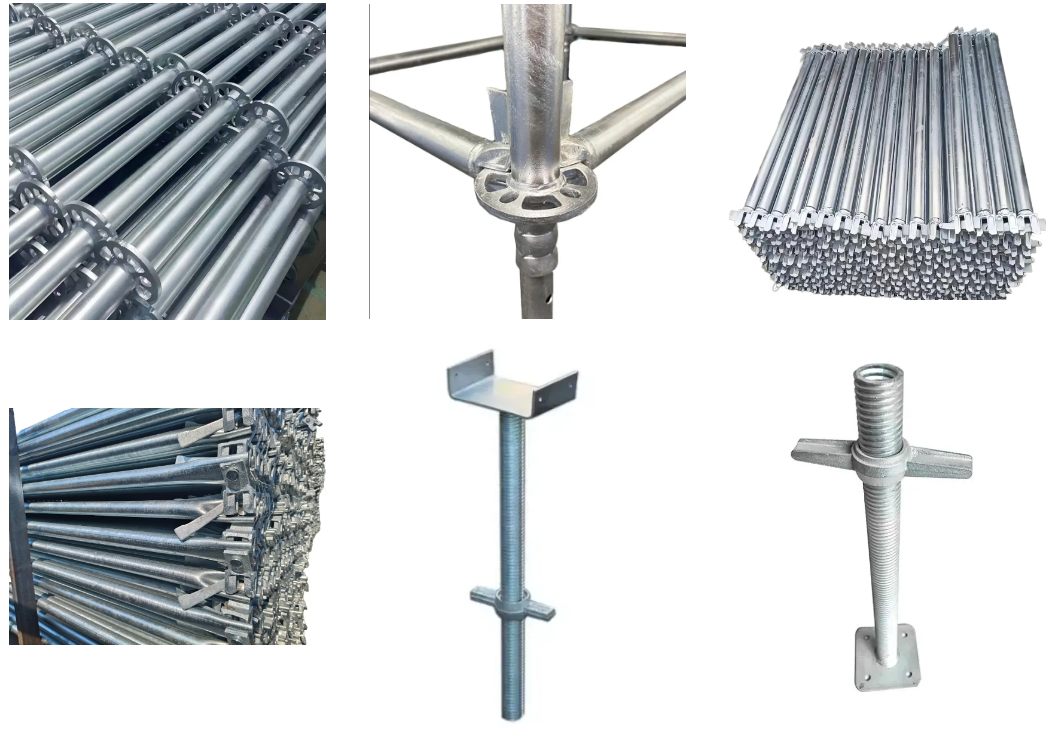
The mechanical anatomy of this component is straightforward but critical. It consists of a threaded stem, a heavy-duty adjustment nut, and a flat base plate. The vertical scaffold leg rests directly on the adjustment nut. By rotating the nut along the threaded stem, you raise or lower the leg to achieve perfect horizontal alignment. You must ensure the threads remain clean and free of concrete splatter to allow smooth operation.
When selecting these components, you will encounter hollow core and solid stem variations. Hollow core jacks are lighter and often feature cross-drilled holes that make internal pinning straightforward. Solid stem jacks offer superior shear strength and load distribution for heavy-duty industrial applications, but they require specific external collar pinning methods to secure the leg properly.
Feature |
Hollow Core Base Jack |
Solid Stem Base Jack |
|---|---|---|
Weight |
Lighter, easier to handle on site |
Heavier, requires more effort to position |
Load Capacity |
Standard commercial loads |
High-capacity industrial loads |
Pinning Method |
Internal cross-drilled holes for toggle pins |
External collar pinning or heavy-duty bolts |
Shear Strength |
Moderate |
Maximum |
Understanding the difference between compressive and tensile forces is essential for safe erection. Compressive forces push down on the structure. These forces naturally seat the vertical leg firmly onto the jack nut. If a structure only ever experienced perfect downward compression, gravity might suffice.
However, construction environments are dynamic. Tensile and uplift forces threaten to separate the leg from the jack. High winds can create a sail effect on scaffold sheeting, pulling the structure upward. Crane snags or shifting material loads can also introduce sudden uplift. Engineering standards require a continuous, uninterrupted load path from the top of the scaffold structure all the way down to the substrate. Mechanical pinning ensures this path remains intact even when uplift forces occur.
Mobile towers require a different approach to base stabilization. Caster stems are designed to insert directly into hollow base jacks or directly into the vertical legs. Because these towers are designed to move, the risk of component separation is significantly higher.
The stem retaining system is the most critical feature of a mobile base. Using toggle pins or locking collars prevents the wheel assembly from dropping out when the tower rolls over floor transitions, debris, or uneven concrete. If a caster drops out during repositioning, the entire tower can tip instantly. You must verify these pins are engaged before unlocking the wheel brakes.
Regulatory bodies leave no room for interpretation regarding base connections. Frameworks such as OSHA 1926.451 explicitly require that adjustment screws, stems, and casters be pinned or otherwise secured inside the scaffold legs. This prevents accidental displacement during use.
During safety inspections, competent persons look for specific success criteria. They verify that every single leg is mechanically locked to its base component. Missing pins, improvised fasteners, or loose locking collars will result in immediate inspection failure. Compliance means using the manufacturer-approved fastening method for every connection point at the ground level.
Verify all base plates are nailed or bolted to mud sills.
Check that adjustment nuts are fully seated against the vertical legs.
Confirm manufacturer-approved pins are installed through the leg and jack stem.
Ensure caster wheel brakes are functional and engaged when stationary.
A secure connection relies heavily on tight manufacturing tolerances. You must evaluate the internal diameter of the scaffold leg against the external diameter of the jack stem. The stem must slide into the leg smoothly but without excessive gaps.
Acceptable tolerances prevent excessive play or lateral shifting at the base connection. If the stem is too narrow for the leg, the structure will wobble, placing undue shear stress on the retaining pin. Always use components designed to work together, preferably from the same manufacturer, to maintain these tight tolerances.
The required strength of the jack-to-leg connection is heavily dictated by site conditions. High wind zones demand robust, high-shear pinning solutions to combat constant uplift. Seismic activity requires connections that can absorb lateral shocks without shearing.
Dynamic loads also play a major role. Material loading zones, active pump jack operations, and the frequent movement of mobile units introduce continuous vibration. This vibration can loosen standard gravity fits over time. Assessing these environmental factors ensures you select a pinning method capable of withstanding the specific stresses of your site.
Mechanical pinning is the most direct way to secure scaffolding bases. The process begins by aligning the pre-drilled holes in the vertical scaffold leg with the corresponding holes in the base jack stem. Once aligned, a fastener is driven through both components.
You must evaluate the trade-offs between different pin types based on your project needs. Toggle pins and pigtail pins offer fast assembly and moderate security, making them ideal for standard facade work. Structural bolts paired with locking nuts provide maximum security and high shear resistance, though they require more time and tools to install. Bolts are typically reserved for heavy industrial or high-vibration environments.
Pin Type |
Installation Speed |
Security Level |
Best Application |
|---|---|---|---|
Toggle Pin |
Fast |
Moderate |
Standard facade scaffolds, light duty |
Pigtail Pin |
Fast |
Moderate |
Frame and buck systems, temporary access |
Structural Bolt & Nut |
Slow |
High |
High wind zones, heavy industrial sites |
Mobile units require strict attention during assembly. Begin by safely inserting the caster stem fully into the adjustment screw or the frame leg. Ensure the wheel brake is locked during this process to prevent the assembly from rolling away.
Next, engage the retaining pin or locking screw. This step is mandatory. The pin must pass completely through the leg and the caster stem. This mechanical lock prevents the wheels from slipping out when the tower is lifted slightly to pass over floor transitions or extension cords.
Modular systems utilize base collars as an intermediary connection point. The base collar acts as a sleeve that sits between the base jack and the first vertical standard. It provides the initial node connection for horizontal ledgers, allowing you to square and level the base before building upward.
To secure this setup, slide the base collar over the jack stem until it rests firmly on the adjustment nut. Pin the collar to the stem using the manufacturer designated fastener. Once the collar is locked to the jack, you can insert the vertical legs into the collar, pinning them as well to complete the continuous load path.
Traditional frame and buck systems require precise alignment over leveling screw jacks. The hollow legs of the frame must slide cleanly over the solid or hollow stems of the jacks. Because these frames are wide, ensuring both legs seat evenly on their respective adjustment nuts is necessary to prevent binding.
Furthermore, the lower frames must act as a single, rigid unit. This is achieved by joining the frames using coupling pins and spring clips. When the entire lower tier is locked together and pinned to the base jacks, the structure resists lateral twisting and maintains its structural geometry under load.
Securing the leg to the jack is entirely negated if the jack itself can slide across the ground. Lateral displacement at the foundation will cause the entire structure to rack and eventually collapse.
You must secure the base plate of the jack to the substrate. On soil or asphalt, nail the base plate through its pre-punched holes directly into heavy timber mud sills. On concrete slabs, use concrete anchors or tapcons to bolt the base plate down. This final step anchors the entire pinned assembly firmly to the earth.
The Ringlock Scaffolding System requires a specific, sequential approach to base assembly. You begin by placing the base jacks on your anchored mud sills. Next, you slide the specialized Ringlock base collars over the jack stems.
These collars feature a rosette node near the bottom. Once the collars are pinned to the jacks, you connect horizontal ledgers between the collars to create a perfectly square, rigid base footprint. Only after this base level is squared, leveled, and pinned do you insert the vertical standards into the base collars.
The interaction at the lowest rosette is what gives the Ringlock system its incredible rigidity. The horizontal ledgers attach to the base collar rosette using wedge heads. When these wedges are hammered home, they create a stiff, moment-resisting connection.
This rigid base level prevents any rotational movement in the vertical legs. Preventing rotation is critical because twisting motions can slowly loosen the jack adjustment nut over time. By locking the base collars together with wedges and pinning them to the jacks, you eliminate the risk of vibration-induced loosening.
The most frequent point of failure is the use of incompatible parts. Mixing components from different manufacturers often results in mismatched thread types or incompatible stem diameters. Mixing hollow-core pins with solid-core jacks can lead to shear failures under heavy loads. Always verify that your components are engineered to fit together seamlessly.
Another major risk involves mobile towers. Failing to pin caster wheels is a leading cause of tip-overs. If a wheel drops into a small depression and the stem is unpinned, the wheel assembly will fall out when the tower is pushed, causing an immediate and violent collapse.
Extending a base jack past its safe working limit severely compromises its load-bearing capacity. The further the nut travels up the stem, the greater the bending moment exerted on the exposed thread. Most manufacturers require a minimum of 6 inches of thread to remain inside the scaffold leg at all times.
To mitigate this risk, never ignore the safety line stamped on the jack stem. If you need more height to reach level, do not over-extend the jack. Instead, use taller base jacks designed for steep slopes, or adjust the foundation level by building up robust, engineered cribbing beneath the mud sills.
A rigorous daily inspection framework executed by a competent person is your best defense against connection failures. The checklist must include physical verification of every base connection.
Inspectors must verify that every pin is fully engaged and locked. They must check that the vertical legs are seated flush against the adjustment nuts. For mobile units, caster lock brakes must be tested daily. Finally, the inspector must confirm that the base plates remain securely anchored to the mud sills or concrete, with no signs of lateral shifting.
Standardize your inventory to ensure all base jacks, collars, and legs share compatible engineering specifications.
Conduct a comprehensive audit of your current base jack inventory to verify pinning capabilities and discard damaged components.
Update site assembly protocols to mandate mechanical fastening at the base level before vertical erection continues.
Train erection crews on the specific pinning and anchoring techniques required for your chosen scaffolding system.
A: Yes, especially to prevent uplift and lateral displacement. OSHA requires stems to be pinned or otherwise secured to the legs to maintain structural integrity.
A: Yes. According to safety regulations, caster wheels and adjustment screw stems must be pinned or otherwise mechanically secured inside the scaffold legs to prevent them from falling out when the scaffold is moved, raised, or subjected to lateral forces.
A: While manufacturer specifications vary, a general rule is to never extend the jack beyond the marked safe working line, typically ensuring at least 1/3 to 1/4 of the stem remains inside the scaffold leg—usually a minimum of 6 inches.
A: Hollow core base jacks are lighter and allow for certain internal pinning styles, whereas solid core base jacks offer higher load capacities but are heavier. Both types must be matched correctly with compatible pinning hardware and frame legs.
A: The base jack provides the adjustable foundation and leveling, while the base collar slides over the jack to provide the first node/rosette connection point for horizontal ledgers and vertical standards.
A: No. Only manufacturer-approved scaffolding pins, such as toggle pins, pigtail pins, or appropriately graded structural bolts with locking nuts, should be used to ensure the connection can withstand calculated shear and uplift forces.
A: Use adjustable scaffolding base jacks set on solid mud sills. Independently adjust each jack nut to level the base, ensure the stems are pinned to the legs, and secure the base plates to the sills.


