


Tel: +86-131-8042-1118
E-mail:
E-mail:
26 Huanghai Road, Leting Economic Development Zone, Hebei Province, China


Views: 0 Author: Site Editor Publish Time: 2026-07-31 Origin: Site


Commercial and industrial construction projects face escalating pressures from labor shortages, strict safety regulations, and compressed timelines. Traditional tube and clamp scaffolding relies heavily on skilled labor to manually measure, level, and torque every structural fitting. This manual process introduces inefficiencies, human error, and safety variables that can derail project schedules and compromise site integrity. When crews spend hours adjusting friction clamps, productivity drops and risk profiles increase.
system scaffolding offers a pre-engineered, modular alternative designed to solve these exact field challenges. By standardizing the erection process, it significantly reduces labor hours while ensuring consistent load-bearing compliance across complex builds. You eliminate the guesswork of manual leveling and replace it with fixed, engineered connection points. This article breaks down the technical architecture, evaluation criteria, and implementation strategies for modular scaffold systems, providing actionable insights for site managers and structural engineers.
Standardized Engineering: System scaffolding relies on prefabricated vertical and horizontal components with fixed connection nodes, eliminating the need for traditional loose steel fittings and reducing human error during assembly.
Labor vs. Capital Trade-off: While requiring a higher initial capital expenditure than traditional scaffolding, modular systems drastically reduce erection and dismantling times, driving long-term ROI on labor-intensive projects.
The Ringlock Dominance: The Ringlock Scaffolding System has emerged as the industry standard for complex geometries, offering up to eight connection points per node for maximum structural rigidity and adaptability.
Risk Mitigation: Successful adoption requires strict inventory management and adherence to manufacturer specifications, as mixing components across different brands can void compliance and compromise structural integrity.
The fundamental architecture of a modular scaffold consists of vertical standards, horizontal ledgers, diagonal braces, transoms, base jacks, and integrated modular decking. These components are manufactured to precise specifications, ensuring a uniform fit across the entire structure. Unlike loose tubes, every piece has a specific, engineered purpose. Fixed connection points, or nodes, are positioned at standardized intervals along the vertical standards. These nodes automatically dictate 90-degree angles during assembly, ensuring structural plumbness without constant manual leveling.
This design eliminates traditional load-bearing couplers, replacing them with wedge-lock, cup-lock, or hook-on fastening mechanisms that secure joints rapidly. When a scaffolder places a ledger into a node, the geometry is already calculated. The system forces the structure into alignment. We can break down the primary components and their functions to understand how the load transfers through the scaffold.
Component | Primary Function | Load Transfer Mechanism |
|---|---|---|
Vertical Standard | Transmits vertical loads to the base | Axial compression through the tube |
Horizontal Ledger | Provides lateral support and guardrails | Transfers horizontal forces to nodes |
Diagonal Brace | Prevents sway and ensures rigidity | Tension and compression resistance |
Base Jack | Levels the scaffold on uneven ground | Distributes point loads to sole boards |
Rosette/Node | Connects multiple components securely | Shear force transfer via wedge or cup |
Bypassing the need for manual measuring and leveling drastically reduces erection time. Projects utilizing modular systems often see a massive reduction in labor hours compared to traditional methods. Workers simply lock the components into the pre-engineered nodes. You do not need a tape measure and a torpedo level for every single connection. The speed advantage becomes highly apparent on large-scale industrial sites where thousands of components are assembled weekly.
While tube and clamp scaffolding offers infinite adjustability for highly irregular facades, modern modular systems accommodate the vast majority of complex geometries with lower risk. Pre-engineered nodes transfer loads predictably, unlike friction-based traditional clamps, which rely entirely on the correct torque applied by the scaffolder. If a worker under-tightens a traditional clamp, the joint can slip. Modular systems remove this variable entirely.
Identify the starting elevation and set the base jacks.
Install the first lift of vertical standards and connect the horizontal ledgers.
Level the base bay using the threaded base jacks before adding further height.
Insert diagonal braces to square and rigidify the initial bay.
Continue adding lifts, locking wedges or cups securely at each node.
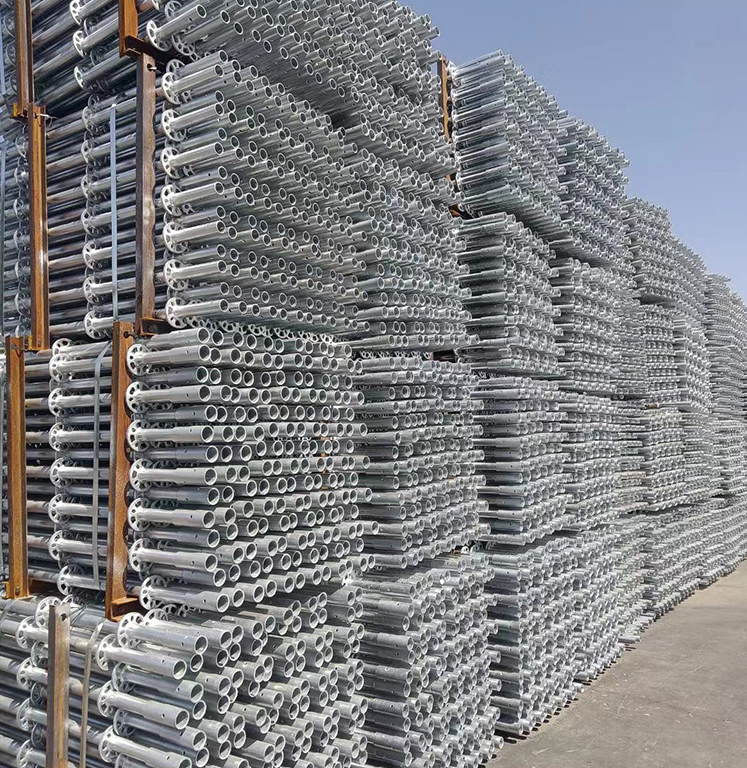
The Ringlock Standard serves as the vertical backbone of the structure. Constructed from high-strength galvanized steel, it provides the primary load-bearing support. Its durability ensures long-term performance in harsh industrial environments, resisting corrosion and mechanical wear. The steel grade used in these standards is specifically chosen for its high yield strength, allowing the scaffold to support heavy industrial loads without buckling.
The defining feature is the rosette node. Fixed rosettes are welded to the standard at precise intervals, typically every 500mm. Each rosette allows for up to eight simultaneous connections, featuring four fixed right angles and four variable angles. This design maximizes connection options at a single point, allowing scaffolders to build complex, multi-directional structures from a single vertical post.
The Ringlock Scaffolding System utilizes a highly effective wedge-lock mechanism. The captive wedge on ledgers and braces slots directly into the rosette. A single hammer blow secures the joint tightly, creating a rigid and stable connection. The wedge is designed to bind tighter as load is applied, ensuring the joint cannot accidentally dislodge during use.
This secure fastening results in exceptional rigidity and vibration resistance. The high load-bearing capacity makes it suitable for heavy-duty industrial applications, complex shoring structures, and suspended scaffolds where structural failure is not an option. Engineers can calculate load paths with high confidence because the node connections have tested, predictable shear and moment capacities.
The variable angle connections on the rosette give the system immense flexibility. It adapts easily to circular structures, curved facades, and complex industrial piping environments. Scaffolders can navigate difficult obstacles without resorting to time-consuming custom fitting. For example, when wrapping a cylindrical storage tank, the variable holes in the rosette allow the ledgers to follow the curve perfectly, maintaining a tight, safe working platform around the entire perimeter.
Ringlock systems utilize high-strength modular rosettes that accommodate up to eight connection points. They are best suited for complex industrial plants, petrochemical facilities, shipbuilding, and highly irregular architectural facades where adaptability is crucial. The ability to run ledgers at non-right angles makes it the go-to choice for heavy industrial maintenance.
Cuplock systems feature top and bottom cups that lock up to four horizontal components to a vertical standard using a single hammer blow on the top cup. They are highly effective for straight-run facades, heavy-duty shoring grids, and civil engineering concrete pours. The node is extremely robust and resists damage well on rough construction sites.
Kwikstage utilizes V-pressings welded to standards at regular intervals, combined with captive wedges on horizontal components. This system is popular for residential builds, commercial masonry, and standard exterior painting or rendering projects. It is straightforward to erect and provides a clean, flush working deck.
Haki systems use hook-on pockets and beam-based connections that prioritize rapid, crane-assisted installations. They are ideal for temporary weather protection roofs, suspended public pedestrian bridges, and heavy-duty stair towers. The components are often lighter, allowing for larger prefabricated sections to be lifted into place.
These systems consist of rigid welded frames coupled with cross-bracing and modular jack components. They provide robust support for vertical concrete formwork, high-clearance shoring towers, and heavy infrastructure projects. They are less about access and more about supporting massive vertical loads during concrete curing.
Quick-erect systems use slide-and-wedge node points optimized for rapid assembly with minimal tools. They are best used for standard maintenance access, light commercial work, and interior drywall or ceiling applications. They are lightweight and easy to transport in smaller vehicles.
Modular scaffolding is ideal for large-scale industrial maintenance, petrochemical plants, shipyards, and high-rise commercial construction. Its rapid assembly makes it the backbone for public events, supporting temporary grandstands, concert stages, camera towers, and pedestrian access ramps. The speed at which these structures can be erected and dismantled is critical for event organizers working under strict venue rental timeframes.
However, highly erratic architectural features or extremely confined footprints might still necessitate hybrid approaches. In these rare cases, combining modular systems with traditional tube and clamp methods provides the necessary flexibility. You might use a modular base structure and tie in traditional tubes to navigate around a complex, protruding architectural cornice.
While the upfront material cost of modular scaffolding is higher than traditional tubes and fittings, the compounding savings in erection and dismantling labor hours drive significant returns over multiple project lifecycles. Faster turnaround times allow contractors to take on more projects with the same crew size. When you reduce the time spent on the scaffold assembly, the follow-on trades can start their work sooner, accelerating the entire project schedule.
Fixed-node systems inherently enforce safety by removing the variable of incorrect clamp torque. They meet stringent safety standards, including OSHA and EN 12810/12811, through predictable, manufacturer-tested load data, ensuring compliance across job sites. Safety inspectors prefer modular systems because a visual inspection easily confirms if a wedge is driven home or a cup is locked, whereas checking traditional clamps requires physically testing the torque on hundreds of fittings.
Mixing system components from different manufacturers presents a critical risk. Cross-brand mixing voids manufacturer warranties, invalidates engineered load data, and introduces severe liability in the event of a structural failure. Even if two brands look identical, slight variations in steel grade, wall thickness, or rosette casting can drastically alter the load capacity. Always source components from a single, reputable manufacturer and quarantine any foreign material found on site.
Storing, tracking, and transporting pre-engineered components of varying fixed lengths requires organized logistics. Implementing digital inventory tracking solutions prevents component loss and ensures that complete, correct kits are dispatched to job sites. Unlike traditional tubes that can be cut to size, modular components must be ordered and shipped in the exact lengths required by the scaffold design.
Transitioning workforce skills is necessary. Scaffolders must move from traditional tube and fitting techniques to understanding system-specific erection manuals and safety protocols. Proper training ensures the system is erected safely and efficiently. Crews need to learn how to read modular scaffold drawings and understand the specific bracing patterns required by the manufacturer to maintain structural stability.
Audit your current scaffolding labor hours to identify specific projects where erection speed is causing schedule delays.
Review your upcoming project pipeline to determine which sites have the standardized geometries best suited for modular systems.
Consult with a structural engineer to request load data and verify compliance with your local safety regulations.
Arrange a pilot project quote with a single-source manufacturer to test the erection speed and logistical flow on a controlled site.
A: System scaffolding uses prefabricated components with fixed connection nodes for rapid assembly. Tubular scaffolding uses loose steel tubes and friction-based clamps, requiring manual measuring and leveling, which takes more time and skill.
A: It features a rosette node that allows up to eight connections at various angles. This flexibility lets it easily adapt to circular structures, curved facades, and complex industrial layouts without custom fabrication.
A: No. Mixing components from different brands voids warranties, invalidates engineered load data, and creates severe safety and liability risks due to slight manufacturing variations in steel and node dimensions.
A: It is the vertical load-bearing component made of high-strength steel. It features welded rosettes at fixed intervals, providing the engineered connection points for horizontal ledgers and diagonal braces.
A: Fixed connection nodes eliminate the risk of incorrect clamp torque. Pre-engineered components ensure predictable load capacities and structural plumbness, significantly reducing human error during the erection process.
A: Erection times are significantly reduced because workers simply lock components into pre-measured nodes, bypassing the need for constant manual leveling, measuring, and torque-wrenching required with traditional methods.


