


Tel: +86-131-8042-1118
E-mail:
E-mail:
26 Huanghai Road, Leting Economic Development Zone, Hebei Province, China


Views: 0 Author: Site Editor Publish Time: 2026-06-19 Origin: Site


Project and procurement managers continuously face immense pressure on active jobsites today. They must actively balance rapid site erection times against rigorous load-bearing and safety compliance constraints. Traditional tube-and-fitting frameworks often fall short because they demand heavy manual effort. These outdated methods drastically drive up labor hours and severely delay critical project timelines. Modern construction scale requires reliable, efficient modular solutions.
This guide provides a highly transparent, technical evaluation of the Cuplock framework to streamline your planning. You will learn exactly how its node-point mechanics operate in the field. We will examine essential procurement specifications and practical deployment risks. Finally, we explore how it directly compares to alternative modular setups. This ensures you can confidently aid your team in strategic vendor selection.
Speed & Labor: Cuplock relies on a unique node-point locking mechanism that fastens up to four horizontals in a single action, significantly reducing erection time compared to traditional methods.
Structural Integrity: Designed for high load-bearing applications, making it ideal for heavy masonry, concrete support, and industrial maintenance.
The Primary Alternative: While highly rigid, projects requiring complex, multi-angle geometry often weigh Cuplock against a Ringlock Scaffolding System.
Procurement Risk: Component compatibility and steel grade verification (e.g., Q235 vs. Q345) are critical when evaluating suppliers to avoid safety and compliance failures.
At the heart of this modular structure lies its highly engineered node-point design. A fixed lower cup is securely welded directly to the vertical standard at precise 500mm intervals. Above this fixed point sits a movable, sliding upper cup. This specific geometric configuration dictates exactly how horizontal members attach to the main vertical load bearers.
The locking action itself is remarkably straightforward and tactile. Workers simply insert the forged ledger blades directly into the fixed lower cup. They then drop the sliding upper cup over these inserted blades. A single, firm hammer blow rotates the upper cup along its cam profile. This action locks the cup firmly into place. This single motion securely fastens up to four horizontal components simultaneously.
This streamlined design delivers massive engineering benefits. Traditional methods require workers to manually tighten individual nuts using heavy steel wrenches. That process fatigues hands and slows down production. The sliding cup mechanism entirely bypasses threaded fasteners. You will find no loose fittings or easily cross-threaded bolts here. Eliminating small, detachable parts inherently reduces the risk of lost components on chaotic sites. It greatly minimizes human error during assembly. The resulting structure acts as a highly rigid, load-resistant framework ready for demanding vertical loads. We consistently see error rates plummet when crews switch from loose clamps to these captive-cup nodes.
Understanding individual components helps procurement teams avoid costly specification errors. Each element plays a distinct role in structural stability.
Vertical standards act as the primary structural backbone of the entire grid. High-yield steel tubes typically form these upright components. The industry standard utilizes a 48.3mm outer diameter (OD). Buyers must carefully verify wall thickness during procurement. A 3.2mm wall provides adequate standard support for general access. However, a 4.0mm wall thickness significantly increases heavy-duty load ratings for shoring. The top of each standard features an internal spigot joint. This spigot aligns the next vertical tube perfectly during vertical stacking. You must always match the internal steel grade to your specific project demands.
Ledgers and transoms function as the vital structural connectors. They bridge the vertical standards and provide critical platform support. We strongly advise examining the manufacturing method of the ledger blades. Forged ledger blades offer much higher durability and impact resistance. They withstand years of hammer strikes. Pressed blades cost less upfront but can deform under heavy impact over time. Transoms feature a specific lip design. This lip securely holds standard scaffolding boards safely in place.
Uneven terrain plagues nearly every construction site globally. Base jacks and head jacks are absolutely critical for precise leveling. Base jacks distribute the massive structural load safely into the ground beneath. They use a threaded stem for micro-adjustments. Concrete formwork relies heavily on U-head jacks at the top. These U-heads cradle primary timber or steel shoring beams securely.
Surface treatments completely dictate the operational lifespan of your equipment. Buyers typically choose between two primary finish types:
Hot-Dip Galvanized (HDG): This remains the gold standard for heavy industry. HDG forms a metallurgical bond with the steel substrate. It offers superior longevity for offshore, coastal, and harsh industrial environments. It resists aggressive handling perfectly.
Painted Finishes: Painted bare steel presents a noticeably lower upfront cost. However, paint chips easily during truck transport and yard handling. Exposed steel then rusts rapidly. This option requires much higher long-term maintenance.
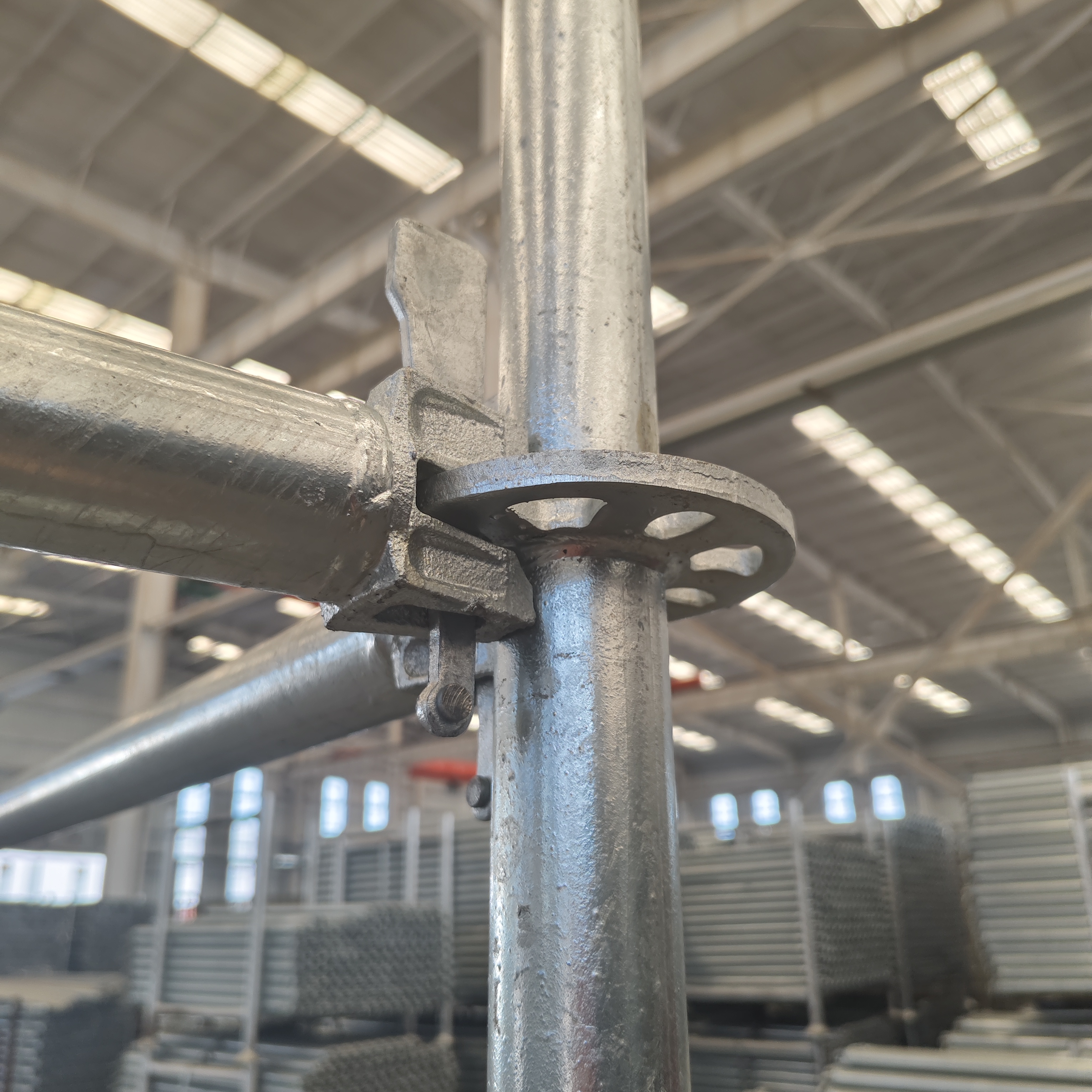
Selecting the optimal structural support requires careful site analysis. You must balance immediate operational needs against strict engineering constraints to ensure a safe, efficient build.
Project planners constantly manage a strict trade-off between vertical load capacity and overall erection speed. Cuplock offers an optimal balance for specific architectural layouts. It shines brilliantly on straight-run facades, high-capacity shoring, and heavy-duty support structures. Workers assemble it quickly because of the unified four-blade node. A single hammer strike secures the grid. Yet, it maintains the sheer vertical strength required for massive concrete pours. It routinely outpaces traditional frame setups by up to thirty percent in sheer erection speed without sacrificing load integrity.
You must assess its utility across different demanding commercial sectors. Commercial construction and infrastructure bridges heavily rely on its robust load-bearing traits. Oil and gas turnarounds also benefit immensely from its rapid deployment. Many planners falsely assume the rigid 90-degree connections severely limit curved builds. However, you can accommodate circular structures seamlessly. By utilizing specialized curved ledgers bent to precise radii, crews can perfectly map the system around cylindrical storage tanks and cooling towers.
Procurement teams must continuously prioritize internationally recognized compliance. You cannot compromise on structural safety regulations under any circumstances. Always procure systems strictly meeting established regional and international benchmarks. Key frameworks include OSHA guidelines in the United States, EN 12810 in Europe, and BS 1139 parameters. These codes specifically govern the strict dimensions and material yields of the 48.3mm tubes. For Middle East operations, strict adherence to Saudi Aramco standards remains absolutely essential for site approval. We strongly advise buyers to demand certified mill test reports directly from vendors before accepting any delivery.
Modular designs vary heavily in their fundamental connecting mechanics. Understanding these mechanical differences helps prevent costly procurement mistakes.
The defining structural difference lies in the use of cups versus rosettes. Cuplock firmly secures horizontal ledgers at rigid 90-degree angles. This specific trait makes it perfectly suited for standard rectangular building grids. Conversely, the Ringlock Scaffolding System uses an intricate 8-hole rosette plate. This advanced rosette allows workers to create flexible 45-degree and multi-directional connections off a single vertical standard. It utilizes a captive wedge pin rather than a sliding cup.
Ringlock generally proves vastly superior for highly complex, irregular geometries. Industrial sites like chemical refineries contain dense, weaving pipework. Staging arenas and event structures also feature unusual shapes. These unique environments demand varied connection angles to bypass structural obstacles easily. Cuplock natively excels in straightforward, heavy-load environments where simple grid patterns dominate the architectural blueprint.
Manufacturing stamped steel cups takes far less complex tooling than cutting precision rosettes. Consequently, Cuplock is typically more cost-effective to manufacture. It presents a lower barrier to entry for bulk procurement upfront. Ringlock parts take longer to forge, weld, and inspect. It requires a notably higher initial capital outlay. However, it often yields remarkably faster erection times on geometrically complex architectural builds where strict 90-degree grids fail to fit.
Use the following structural comparison chart to shortlist your modular approach rapidly based on site realities.
Feature Category | Cuplock Profile | Ringlock Profile |
|---|---|---|
Node Mechanism | Fixed Lower Cup & Sliding Upper Cup | 8-Hole Rosette Plate & Wedge Pins |
Connection Angles | Strictly 90 degrees (fixed grid) | Multiple variations (45 to 90 degrees) |
Best Application | Straight facades, shoring, masonry grids | Complex geometries, refineries, event stages |
Manufacturing Complexity | Standardized globally, highly optimized | Requires precision laser cutting and forging |
Upfront Procurement Need | Generally Lower Capital Intensity | Generally Higher Capital Intensity |
Even premium frameworks fail catastrophically if improperly sourced or poorly managed. Careful vetting guarantees a stable, compliant site layout.
A unified Scaffolding System relies heavily on precise dimensional tolerances at every node. Mixing components from different global manufacturers can severely compromise overall structural integrity. Even a tiny two-millimeter deviation in cup placement creates massive node stress. A small gap allows the horizontal ledger to sway slightly. Over a 10-meter vertical tower, this tiny sway amplifies into dangerous structural wobble. Buyers must rigorously verify exact dimensional tolerances before mixing any legacy inventory with newly purchased stock.
The global steel market harbors significant hidden quality risks. Substandard foundries sometimes deliberately mask low-grade steel beneath thick, shiny galvanization layers. Lower grade Q235 steel bends under peak shoring loads. Higher grade Q345 steel resists yield stress significantly better. We highly recommend requesting detailed mill test certificates prior to placing an order. Always demand independent, third-party material testing reports. Ensure standard tubes genuinely meet high-yield benchmarks where extreme vertical loads are expected.
Site management fundamentally includes efficient material handling. The fixed nature of the cups means vertical standards stack quite efficiently in the storage yard. However, buyers must explicitly account for specific stillages. You need proper steel racks to transport loose ledgers and standards securely without transit damage. Proper steel stillages prevent heavy tubes from rolling dangerously during flatbed transit. Large-scale rental fleets demand well-planned transport logistics. Good yard layout groups components perfectly by size, slashing truck loading times drastically.
Strategic procurement fundamentally shapes site safety and overall project velocity. A well-manufactured Cuplock setup remains a top-tier choice for contractors globally. It heavily prioritizes reliable speed, impressive durability, and high vertical load capacity on standard architectural geometries.
To ensure successful deployment across your sites, follow these actionable next steps:
Audit your upcoming project portfolios meticulously to determine prevailing geometry types and exact load capacity requirements.
Request detailed technical drawings and preliminary engineering load calculations directly from all shortlisted vendors.
Verify all international compliance certifications, particularly EN 12810 and localized safety mandates, before officially issuing a Purchase Order.
Establish a strict internal operational policy prohibiting the mixing of incompatible structural components from unverified secondary suppliers.
A: Load capacity heavily depends on the vertical ledger spacing and the specific steel grade used. Typically, a high-yield standard made of Q345 steel with 4.0mm walls, braced at 1.5-meter intervals, safely supports loads exceeding 50kN to 74kN per leg. You must always consult the manufacturer's certified engineering data for precise site-specific load classes.
A: Yes, you can use it for suspended setups, but it carries strict limitations. The node joints are primarily engineered for compression, not tension. Suspended configurations require rigorous specific engineering calculations. You must use reinforced tension splices and safety locking pins to prevent joint separation under active gravitational pull.
A: Tube and clamp fittings are frequently used to bridge awkward architectural gaps or tie grids into existing solid structures. However, the core structural nodes and primary vertical load-bearing columns must remain purely Cuplock. Mixing load-bearing systems arbitrarily degrades the engineered load ratings and introduces highly unpredictable weak points.
A: When sourced from quality certified manufacturers, hot-dip galvanized components offer an exceptional lifespan. You can realistically expect 15 to 20 years of active operational service. Coastal or highly corrosive industrial chemical environments may slightly reduce this duration. Routine physical inspection and proper yard storage further extend the functional life.


