


Tel: +86-131-8042-1118
E-mail:
E-mail:
26 Huanghai Road, Leting Economic Development Zone, Hebei Province, China


Views: 0 Author: Site Editor Publish Time: 2026-08-04 Origin: Site


Modern industrial and commercial construction projects require access solutions that balance rigorous safety compliance with rapid erection times. Site managers constantly face the challenge of selecting the right equipment for complex builds. Traditional tube-and-clamp scaffolding is highly adaptable but heavily reliant on skilled labor. It takes considerable time to erect and dismantle, slowing down project schedules. Conversely, standard frame scaffolding goes up fast but fails to accommodate complex architectural geometries or heavy industrial loads. This leaves a massive gap in access strategy for demanding job sites.
The engineered middle ground is the modular system scaffold. It is a prefabricated access solution designed with fixed connection points. This equipment eliminates the guesswork of loose fittings while maintaining high structural integrity. This technical evaluation guides procurement officers, site managers, and safety directors. It provides the necessary field data to decide whether to transition to or invest in modular system scaffolding for upcoming projects.
Engineered Modularity: System scaffolds utilize prefabricated vertical and horizontal components with fixed node points, drastically reducing human error and erection time compared to traditional methods.
The Ringlock Standard: The Ringlock scaffolding system has emerged as the global industry standard due to its 360-degree rosette nodes, allowing up to eight connections per node for complex geometries.
Compliance and Risk: Standardized components simplify load calculations and safety inspections, making it easier to maintain compliance with OSHA, ANSI, and EN regulations.
A system scaffold relies on pre-engineered components that interlock securely. Workers do not need loose fittings or specialized tools to build the structure. A standard hammer is usually sufficient to lock the components in place. This design principle ensures consistent node strength across the entire build. Fixed connection points dictate the exact spacing of horizontal and vertical members. This inherent geometry automatically aligns the structure, reducing the risk of human error during assembly.
Several typologies dominate the global market, including Ringlock, Cuplock, and Kwikstage. The Ringlock Scaffolding System has largely surpassed older locking mechanisms like cup-and-blade or T-bar designs. Ringlock offers superior speed and higher node capacity. Its rosette design provides unmatched geometrical versatility. Workers can create circular, curved, or irregular structures easily. Older systems often struggle with multi-directional connections at a single node, limiting their use on complex industrial sites.
Comparing a system scaffold to traditional tube and clamp reveals stark operational differences. Tube and clamp offers infinite adjustability for highly irregular spaces. However, system scaffolding provides superior speed and standardized load capacities. These capacities rely on 48.3mm outer diameter high-tensile steel tubing. System scaffolds also reduce inventory loss because they use far fewer loose couplers. Site managers spend less time tracking small parts and more time advancing the build schedule.
System scaffolding also outperforms standard frame scaffolding in demanding environments. Heavy industrial applications, petrochemical refineries, and complex facades require robust support. Standard H-frames cannot safely navigate piping obstacles or support heavy duty loads. System scaffolds adapt to the structure's exact profile. They provide safe, high-capacity working decks exactly where tradespeople need them. The modularity allows for bypasses around structural steel, ductwork, and existing machinery without compromising the scaffold's stability.
To understand the operational shift, consider the labor dynamics on a large commercial site. Erecting a 50-foot tower with tube and clamp requires constant leveling, measuring, and tightening of individual couplers. A system scaffold tower of the same height goes up in a fraction of the time. The fixed nodes ensure the lifts are automatically level, provided the base is set correctly. This predictability allows project managers to forecast labor requirements with high accuracy.
Scaffold Feature | System Scaffold (Ringlock) | Tube & Clamp | Frame Scaffold |
|---|---|---|---|
Erection Speed | Fast (Fixed nodes) | Slow (Manual measuring) | Very Fast |
Load Capacity | Heavy-Duty (75+ psf) | Variable / Medium | Light to Medium |
Geometrical Adaptability | High (360-degree rosettes) | Very High | Low (Rigid frames) |
Component Tracking | Simple (Standardized parts) | Complex (Many loose fittings) | Simple |
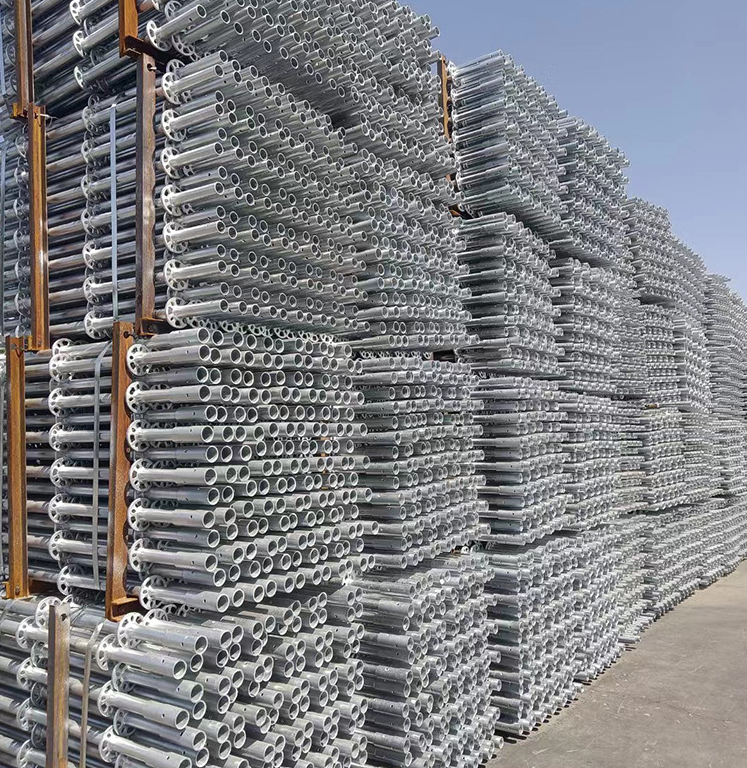
The core vertical support component is the Ringlock Standard. This vertical post features welded rosette nodes spaced at standard intervals, typically every 500mm. These rosettes dictate the structural geometry and lift heights of the entire tower. The standard utilizes 48.3mm diameter hot-dip galvanized steel tubing. This provides exceptional compressive strength and corrosion resistance. The spigot at the top of each standard allows for seamless vertical stacking, transferring loads directly down the tube axis.
Ledgers and transoms form the horizontal framework. Ledgers act as guardrails and structural ties between vertical posts. Transoms provide the specific seating for scaffolding planks and steel decks. The engineering behind these components is precise. Ledger end-castings feature wedge-pin connectors that slide onto the rosette. This creates a rigid, right-angle connection instantly. The wedge pin is captive, meaning it cannot be dropped or lost during assembly, which is a massive advantage over loose fittings.
Diagonal bracing prevents structural sway and maintains tower rigidity. Bay braces handle dynamic loads from wind and worker movement. They feature swivel wedge-head connections. These swivel heads allow for multi-angle configurations, adapting to different bay lengths and lift heights. Proper bracing ensures the scaffold transfers lateral forces safely to the ground. Without adequate diagonal bracing, even the strongest vertical standards will buckle under side loads.
The gravity-lock wedge mechanism is the heart of the connection. The wedge pin forms a structural, self-locking joint with the rosette. Gravitational force pulls the wedge down. A simple hammer strike drives it home. This creates a rigid, load-bearing joint that resists rotation and uplift. The connection remains secure even under heavy vibration from nearby machinery or heavy foot traffic. Inspectors can visually verify a secure connection by checking the depth of the wedge pin.
Base collars and jacking systems form the foundation. Adjustable base jacks distribute the scaffold load safely to the ground. They allow workers to level the structure on uneven terrain. The base collar slides over the jack, providing the initial rosette connection point for the lowest ledgers. This ensures the base remains perfectly square and plumb. A solid foundation is non-negotiable; any deviation at the base multiplies as the tower gains height.
Set the adjustable base jacks on solid mudsills to distribute the load.
Slide the base collars over the jacks to establish the starting node height.
Connect the base ledgers and transoms to the collars to form a square, level footprint.
Insert the first tier of vertical standards into the base collars.
Install the next level of ledgers and transoms at the required lift height.
Attach diagonal bay braces to square and rigidify the structure.
Install steel decks or planks on the transoms to create the working platform.
Add toe boards and guardrails to meet fall protection standards.
Procurement teams must evaluate load-bearing capacities strictly. Scaffolds fall into light-duty (25 psf), medium-duty (50 psf), and heavy-duty (75+ psf) categories. The rosette connection strength directly dictates the overall tower capacity. Engineers calculate the maximum leg load based on the vertical distance between horizontal ties. Shorter lift heights increase the load capacity of the vertical standards. Procurement must request comprehensive load charts from the manufacturer to verify these capacities against site requirements.
Material specifications and metallurgy are critical evaluation points. Hot-dip galvanized steel is the industry standard for longevity and heavy loads. Manufacturers typically use Q345 or Q235 grade steel. The galvanization process coats the steel in zinc, protecting it from rust and degradation. Aluminum system scaffolds serve a different purpose. They are ideal for weight-restricted areas, internal tank inspections, or suspended applications. Aluminum offers easier handling but lower overall load capacities compared to steel.
Quality assurance and manufacturing standards separate reliable suppliers from risky ones. Procurement teams must verify critical QA benchmarks before purchasing. Look for AWS welding certifications and ISO 9001 compliance. Hot-dip galvanization thickness must meet ASTM A123 standards. Consistent weld quality ensures the rosette nodes will not fail under shear stress. A single weak weld on a rosette can compromise an entire scaffold tower, leading to catastrophic failure.
Adaptability to complex geometries adds immense value to the equipment fleet. A quality system scaffold can build circular structures for tanks and silos. It easily configures into suspended scaffolds or cantilevered access platforms. Workers achieve these complex builds using standard off-the-shelf components. This eliminates the need for expensive, custom-fabricated access solutions. The ability to pivot from a straight facade build to a complex boiler internal using the same inventory maximizes equipment utilization.
When evaluating suppliers, consider the dimensional tolerances of the components. Tight tolerances ensure that ledgers and braces fit snugly onto the rosettes without excessive play. Loose connections lead to a wobbly structure, which reduces worker confidence and overall safety. Requesting a sample batch for a pilot build in the yard is a practical way to test these tolerances before committing to a large purchase order.
Component | Material Specification | Primary Function | Inspection Focus |
|---|---|---|---|
Vertical Standard | Q345 Galvanized Steel | Vertical load transfer | Straightness, rosette weld integrity |
Ledger | Q235 Galvanized Steel | Horizontal tie, guardrail | Wedge pin movement, end-casting welds |
Diagonal Brace | Q235 Galvanized Steel | Lateral stability | Swivel head rotation, pin engagement |
Base Jack | High-Tensile Steel | Leveling, load distribution | Thread condition, base plate flatness |
Heavy industrial maintenance heavily relies on modular scaffolding. Petrochemical refineries present extreme access challenges. System scaffolds navigate dense pipe racks, spherical storage tanks, and high-pressure boilers effectively. The modular components fit through narrow manways. Workers then assemble high-capacity platforms inside confined spaces safely. The fixed nodes allow for rapid assembly in environments where time is strictly limited by plant shutdown schedules.
Commercial building and facade engineering also benefit greatly. Modern architecture rarely features flat, straight walls. Modular scaffolding accommodates complex architectural curves, deep cantilevers, and irregular building envelopes. The system steps in or out easily to follow the facade profile. This keeps workers close to the work surface, improving ergonomics and safety. Masons, glaziers, and painters require stable, wide platforms that only a heavy-duty system can provide.
Infrastructure, civil engineering, and shoring represent heavy-duty applications. System scaffold configurations serve as temporary pedestrian bridges. They function as heavy shoring towers for structural concrete support. The high compressive strength of the vertical standards handles massive vertical loads. Engineers rely on the predictable load data of standardized components for critical shoring designs. The ability to interlock towers with horizontal ledgers creates massive, stable shoring blocks for bridge decks and overpasses.
Niche and specialized use cases demonstrate the system's true versatility. Aviation and aerospace maintenance teams build custom access docks for aircraft fuselages and wing profiles. The scaffolding contours to the aircraft without touching the sensitive skin. Offshore energy sectors use them for wind turbine construction and oil platform maintenance. These environments demand extreme corrosion resistance, making hot-dip galvanized components mandatory. Marine shipyards utilize system scaffolding for temporary dry-dock staging that perfectly matches complex hull contours.
In the event and entertainment industry, system scaffolds provide the structural backbone for concert stages, lighting rigs, and temporary grandstands. The high load capacity supports heavy audio-visual equipment, while the rapid erection speed meets tight event schedules. The black-painted or powder-coated variants of these scaffolds blend into the background, providing safe access without disrupting the visual aesthetics of the production.
Regulatory adherence is non-negotiable on any job site. System scaffolding must meet stringent baseline requirements. In the United States, builds must comply with OSHA Subpart L and ANSI A10.8 standards. European sites follow EN 12810 and EN 12811 regulations. Standardized components make it easier for safety inspectors to verify compliance visually. Missing wedges or improper bracing stand out immediately. Inspectors can quickly count the rosette intervals to verify lift heights and guardrail placement.
The risk of component mixing presents a severe liability. Procurement and site teams must never mix components from different manufacturers. Parts may appear visually compatible with the Ringlock standard. However, small variances in metallurgy, rosette dimensions, and weld tolerances exist. Mixing these parts can lead to catastrophic joint failure. You must rely on single-source engineering data to guarantee structural integrity. A mixed scaffold voids all manufacturer warranties and leaves the contractor fully liable for any failure.
On-site safety training and competency frameworks ensure safe execution. A structured training program is mandatory. Supervisors should hold OSHA Competent Person Training or CISRS international certifications. Workers need specific on-site competencies for system scaffolds. They must understand correct wedge-pin seating and diagonal bracing ratios. They must also know maximum cantilever limits and how to calculate foundation bearing capacities. Ignorance of these specific system rules leads to unstable builds and severe accidents.
Material handling and storage also impact safety and longevity. Dropping ledgers or standards from height damages the end-castings and rosettes. Damaged components will not fit together correctly, forcing workers to use unsafe workarounds. Proper yard storage involves stacking components off the ground on dunnage to prevent mud accumulation and accelerated corrosion. Regular inspections must identify and quarantine bent tubes, cracked welds, or missing wedge pins before they reach the job site.
Fall protection during erection and dismantling is a critical safety focus. System scaffolds allow for advanced guardrail systems. Workers can install the guardrails for the next lift from the safety of the current deck. This continuous protection minimizes the time workers spend exposed to fall hazards. Harnesses and dual-lanyard tie-offs remain mandatory, but the engineered design of the scaffold provides a safer working environment compared to traditional methods.
System scaffolding remains the optimal choice for contractors facing complex structural geometries and stringent safety requirements. It bridges the gap between the adaptability of tube-and-clamp and the speed of frame systems. Standardized components improve safety, speed up erection times, and handle heavy-duty loads reliably. Transitioning to a modular system requires careful planning and strict adherence to manufacturer guidelines.
Request comprehensive engineering load charts from potential scaffold suppliers to verify heavy-duty capacities.
Conduct a pilot build in a controlled yard to assess component tolerances and wedge-pin seating quality.
Verify the supplier's quality assurance documents, specifically AWS welding certifications and ASTM galvanization reports.
Implement a strict single-source inventory policy to prevent the dangerous mixing of incompatible manufacturer components.
A: Frame scaffolds use pre-welded H-frames suited for flat facades and straight walls. System scaffolds use individual vertical and horizontal posts that connect at fixed nodes. This modularity allows for multi-directional builds, circular structures, and complex shapes that rigid frames cannot accommodate.
A: Capacity depends on the specific engineering design, bay size, and bracing configuration. However, standard steel Ringlock systems are routinely engineered for heavy-duty loads exceeding 75 pounds per square foot (psf), making them suitable for masonry and industrial applications.
A: The standard is the vertical support tube of the scaffold system. It features welded rosette rings at regular intervals, typically every 500mm. These rosettes serve as the primary connection points for horizontal ledgers and diagonal braces.
A: No. Mixing components voids manufacturer warranties and invalidates engineering load data. Even slight differences in steel grade, rosette thickness, or wedge-pin angles can cause joint failure, creating significant safety and regulatory compliance liabilities.
A: With proper handling, yard storage, and routine inspection, hot-dip galvanized scaffolding components can remain in safe, operational service for 15 to 20 years or more. The zinc coating protects the high-tensile steel from severe environmental corrosion.


