


Tel: +86-131-8042-1118
E-mail:
E-mail:
26 Huanghai Road, Leting Economic Development Zone, Hebei Province, China


Views: 0 Author: Site Editor Publish Time: 2026-08-01 Origin: Site


Historically, construction relied heavily on labor-intensive tube-and-clamp methods. These traditional setups required workers to measure, align, and tighten individual couplers manually. Modern commercial, industrial, and event-based construction demands standardized, high-speed access solutions. Project managers and procurement teams face escalating labor costs, strict safety compliance mandates, and tight project schedules. Traditional scaffolding simply cannot efficiently support these modern site requirements.
Understanding the strict engineering definition of a system scaffold is critical. The fixed connection architecture dictates how loads transfer through the structure. Evaluating procurement options requires a deep dive into these mechanical differences. Calculating labor return on investment depends on erection speed. Ensuring site safety relies on predictable, repeatable connections. Recognizing these factors helps teams make informed equipment decisions and maintain strict project timelines.
A system scaffold is defined by its prefabricated, fixed connection points (nodes) that eliminate the need for loose, traditional steel fittings, significantly reducing human error during erection.
The architecture relies on modular components—primarily vertical standards, horizontal ledgers, transoms, and locking decks—engineered to lock together at specific, predetermined angles.
The Ringlock Scaffolding System represents the current industry benchmark for system scaffolds, offering eight-point multi-directional connections for complex structural geometries.
While requiring a higher initial capital expenditure than traditional scaffolding, system scaffolds deliver rapid ROI through accelerated erection and dismantling times, directly lowering labor overhead.
Modern scaffolding must meet strict success criteria. Structural predictability is non-negotiable on large sites. Repeatable safety ensures every built bay performs exactly like the last. The design must minimize reliance on worker judgment for load-bearing connections. A modular approach achieves these goals through engineered geometry and fixed load paths.
Pre-engineered locking mechanisms define modular access equipment. These include wedges, cups, and rosettes. Traditional setups use friction-based load-bearing couplers. A friction coupler requires a worker to tighten a nut to a specific torque. If the worker under-tightens the nut, the joint can slip under load. Fixed nodes eliminate this dangerous guesswork. The connection locks into a predetermined slot or ring. This standardizes load distribution across the entire frame. The mechanical difference ensures consistent shear capacity at every joint.
When evaluating node connections on site, inspectors look for specific engagement indicators. A wedge must pass entirely through the rosette slot. The hammer strike must seat the wedge firmly against the lower ring. This metal-on-metal contact creates a rigid joint that resists vibration. Wind loads and dynamic worker movement cannot loosen a properly seated wedge. This mechanical certainty separates modular systems from traditional friction fittings.
System scaffold components feature strict dimensional tolerances. Manufacturers produce these parts in automated facilities using high-yield steel. Fixed lengths of ledgers and transoms control the exact dimensions of each bay. When workers connect a ledger between two vertical posts, the structure automatically squares itself. It also plumbs the scaffold structure with minimal manual adjustment.
This automatic alignment accelerates the build process. Crews spend less time checking levels and more time advancing the build. Standardization also simplifies engineering calculations. Scaffold designers know the exact capacity of a 2.13-meter ledger. They do not have to guess the span distance or the tube wall thickness. This predictability allows for faster sign-offs and safer temporary structures.
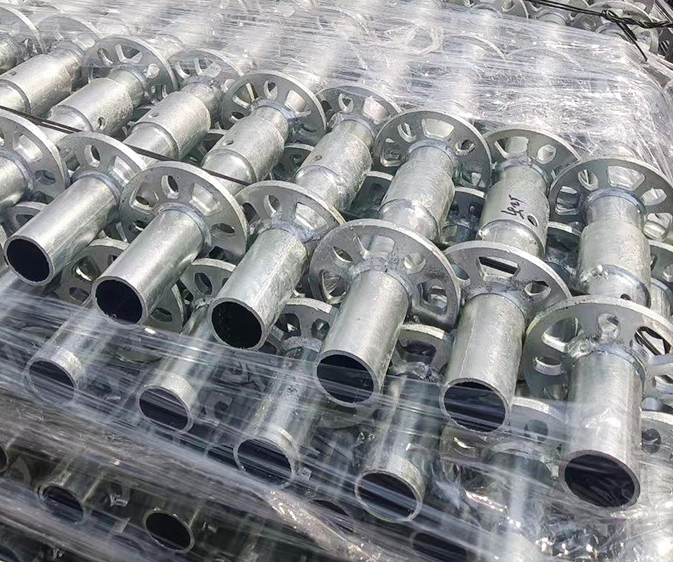
Understanding the universal anatomy of a modular setup guides inventory decisions. It also helps teams evaluate procurement options effectively. Each component serves a specific structural purpose and must integrate seamlessly with the rest of the system.
The vertical load-bearing tube forms the backbone of the structure. It transfers all weight down to the ground. The Ringlock Standard serves as the primary example in modern applications. It features welded rosettes spaced at regular intervals. These intervals typically measure exactly 500mm. The rosettes dictate the connection heights for all horizontal members.
This fixed spacing ensures uniform lift heights across the entire project. Workers always have a connection point at the correct ergonomic height for guardrails. The standard also includes a built-in spigot at the top. This allows the next vertical tube to stack directly on top, transferring the compressive load straight down the tube wall.
Ledgers provide horizontal support between vertical posts. They dictate the longitudinal bay length. Transoms act as transverse members. They span the width of the bay and directly support the scaffold boards or platforms. Diagonal braces prevent structural sway. They connect across the face of the bay, forming rigid triangles.
Install the base collars over the leveling jacks to establish the starting nodes.
Connect the longitudinal ledgers to form the base perimeter.
Install the transverse transoms to lock the bay width.
Level the entire base bay using a spirit level on the ledgers.
Attach diagonal braces to square the bay and provide shear resistance.
This bracing maintains the rigidity of the modular bays under wind or dynamic loads. Without proper diagonal bracing, a scaffold can suffer catastrophic failure through lateral displacement. The fixed lengths of the braces ensure they only fit when the scaffold is perfectly square and plumb.
System scaffolds utilize specifically engineered decks. Manufacturers fabricate these from steel, aluminum, or composite materials. These decks lock directly into the transoms. They feature built-in hooks or claws that grip the horizontal tubes. This design eliminates the safety hazards of loose wooden boards.
It also removes the need for wire ties to secure the walking surface. The integrated decks often include non-slip surfaces and built-in wind uplift locks. When a worker installs a deck, the wind lock engages automatically or with a simple hammer tap. This prevents high winds from dislodging the platform during severe weather events.
Foundation components transfer the scaffold's total load to the ground. A base collar slides over the leveling jack to provide a starting node. Adjustable leveling jacks compensate for uneven site topography. They feature a threaded stem and a heavy-duty base plate.
Workers spin the collar nut to raise or lower the starting height. This ensures the entire structure begins perfectly level, regardless of ground conditions. Proper foundation setup dictates the success of the entire build. If the base is out of level, the error compounds with every vertical lift, eventually making it impossible to connect the fixed-length ledgers.
Specific system designs dominate the global market. Evaluating their technical merits requires looking at node design, material strength, and adaptability to complex site conditions.
The Ringlock Scaffolding System outperforms older system types like Cuplock or Kwikstage. The rosette-and-wedge mechanism provides exceptional high shear capacity. When a worker drives the wedge into the rosette, it creates a rigid, vibration-proof joint. This specific engineering advantage delivers superior structural stability.
It handles heavy industrial loads better than friction-based or cup-based alternatives. The wedge design also allows for visual inspection from a distance. A safety manager can walk the site and immediately see if a wedge is not fully seated. Cup systems often hide the connection point, making visual verification difficult.
The mechanics of the eight-hole rosette offer unmatched versatility. It features four small holes for right-angle connections. These secure the primary ledgers and transoms. It also includes four larger holes for variable-angle connections. These accommodate diagonal braces and non-standard angles.
This multi-directional capability allows the structure to adapt easily. It can wrap around circular tanks, curved facades, or highly irregular building shapes. Traditional systems struggle with these geometries, requiring complex cantilevered tube arrangements. The rosette simplifies this by providing engineered connection points at multiple angles from a single vertical post.
Comparing operational outcomes supports the build-versus-rent decision. It also clarifies the system-versus-traditional debate for contractors looking to optimize their access strategies.
Performance Metric |
System Scaffold |
Traditional Tube and Clamp |
|---|---|---|
Erection Speed |
High (Wedge locks, fixed lengths) |
Low (Manual measuring, wrench tightening) |
Connection Reliability |
Fixed nodes, predictable shear strength |
Friction-dependent, relies on worker torque |
Component Weight |
Optimized high-yield steel |
Standard heavy-wall steel tubes |
Flexibility |
High (Multi-directional rosettes) |
Infinite (but requires high skill) |
Visual Inspection |
Easy (Visible wedge seating) |
Difficult (Requires torque wrench testing) |
Modular systems deliver a significant reduction in labor hours. Crews often erect these structures 30 to 50 percent faster than traditional setups. Wedge-lock connections require only a hammer to secure. Workers do not waste time ratcheting nuts on hundreds of couplers.
This speed translates directly to overall project timeline compression. Faster access means follow-on trades start their work sooner. Dismantling is equally efficient. A quick hammer strike releases the wedge, allowing rapid teardown. This efficiency drastically reduces the labor overhead associated with temporary access.
Pre-engineered joints reduce the risk of scaffold collapse. Collapses often stem from improperly tightened friction couplers. Fixed nodes remove this variable entirely. Built-in safety features enhance site security. Captive wedges remain permanently attached to the ledger ends.
Workers cannot easily lose or drop them from height. This prevents struck-by incidents on busy construction sites. The rigid node connections also reduce sway, providing a more stable working platform. A stable platform increases worker confidence and productivity, as they spend less time worrying about their footing.
A common misconception claims modular systems only work for straight facades. Multi-directional rosettes prove this false. Industrial applications rely heavily on these systems. Boilers, shipyards, and refineries feature complex pipework and curved surfaces.
Modular equipment navigates these obstacles efficiently. The event industry also utilizes this equipment extensively. Concert stages, grandstands, public staircases, and media towers all depend on rapid, rigid modular builds. The ability to create safe, high-capacity structures quickly makes modular systems ideal for time-sensitive event deployments.
Adopting modular equipment involves practical realities. Companies must address hidden costs, logistical shifts, and workforce training requirements to maximize their investment.
Modular components carry a higher initial purchase cost. The engineering and manufacturing processes demand tighter tolerances. Companies must calculate the break-even point carefully. This calculation relies on labor savings and component lifespan.
High utilization rates offset the initial capital expenditure quickly. Reduced erection times lower the labor overhead on every subsequent project. Furthermore, galvanized modular components resist corrosion better than painted traditional tubes, extending their usable lifespan and reducing replacement costs.
Modular systems require a specific logistical footprint. Racks and stillages help organize the fixed-length components. Strict inventory control becomes an absolute necessity. Missing a specific ledger length can halt a modular build completely.
Traditional tubes allow workers to simply cut or overlap material to bridge a gap. Modular builds demand exact part counts before mobilization. Yard managers must implement robust tracking systems to ensure every shipment contains the precise mix of standards, ledgers, and braces required by the engineering drawings.
Scaffolding crews transitioning from tube-and-clamp face a learning curve. They must learn to read modular design drawings. Manufacturer-specific training ensures correct wedge seating. Crews must also understand specific bracing patterns required by the system manual.
Proper training prevents improper assembly and ensures the structure meets engineered load ratings. Supervisors must enforce strict adherence to the manufacturer's build sequence. Shortcuts that worked with traditional tubes often compromise the structural integrity of a modular system.
Regulatory and engineering standards govern all temporary access deployments. Strict adherence protects workers, limits liability, and ensures structural stability under load.
Engineers assign specific duty ratings to scaffold bays. These ratings classify as Light, Medium, or Heavy duty. The rating depends on the weakest component in the modular bay. Contractors must rely on manufacturer-provided technical data.
Load tables dictate the exact capacity of ledgers and standards. Generic scaffolding assumptions do not apply to engineered modular systems. Site managers must keep these load tables accessible and ensure that material loading on the platforms never exceeds the specified limits.
Mixing components from different manufacturers creates a critical safety hazard. Slight metallurgical differences alter load capacities. Millimeter variances in a rosette can prevent a wedge from seating fully.
This compromises the entire structural integrity. Mixing parts also voids manufacturer warranties. It violates compliance with most regional safety regulations. Procurement teams must establish strict vendor controls to ensure all components on a site originate from a single, certified manufacturing source.
Audit your upcoming project access requirements based on geometric complexity and load demands.
Consult with a scaffolding engineer to develop a 3D modular design before procurement.
Request verified load-bearing documentation and material certificates from potential suppliers.
Audit your current inventory storage capabilities to accommodate modular racks.
Schedule manufacturer-certified training for your erection crews prior to deployment.
A: A system scaffold uses prefabricated, fixed connection points like rosettes and wedges. Traditional tubular scaffolding uses loose steel pipes and friction-based bolted couplers that require manual measuring and tightening.
A: The connection point is defined by a pre-engineered node, such as a welded ring or cup on the vertical post, which accepts locking mechanisms from horizontal and diagonal members.
A: A ledger runs longitudinally to connect vertical posts and dictate bay length. A transom runs transversely across the bay to directly support the walking decks or scaffold boards.
A: It offers an eight-hole rosette that allows for multi-directional connections. This provides high shear capacity, rapid wedge-lock assembly, and the flexibility to build around complex structures.
A: Yes. Because the components are fixed lengths and use hammer-driven wedge locks, crews can erect and dismantle the structure 30 to 50 percent faster than traditional methods.
A: No. Mixing components is a severe safety hazard. Slight differences in manufacturing tolerances and metallurgy can compromise joint strength and void safety certifications.


