


Tel: +86-131-8042-1118
E-mail:
E-mail:
26 Huanghai Road, Leting Economic Development Zone, Hebei Province, China


Views: 0 Author: Site Editor Publish Time: 2026-07-29 Origin: Site


Labor costs, tight schedules, and strict safety rules push site managers away from traditional tube-and-fitting setups toward modular solutions. Procurement officers face a specific challenge: balancing the higher initial capital expenditure of modular systems against required load capacities, site adaptability, and long-term labor savings. Evaluating the specific structural and operational characteristics of system scaffolding is the only objective way to determine if it aligns with a project’s geometric complexities and safety requirements. You need to know exactly how these modular components behave under load, how they connect, and where they outperform older methods. This guide breaks down the technical specifications, connection mechanics, and operational realities of modular scaffolding to help you make informed equipment decisions for heavy industrial and commercial applications.
Engineered Modularity: System scaffolding relies on prefabricated, standardized components that lock together at fixed intervals, drastically reducing human error during erection.
Omnidirectional Flexibility: The defining structural trait is the ability to connect horizontal members in a nearly 360-degree fashion around vertical posts, allowing adaptation to complex architectural geometries.
Superior Load Distribution: Fixed node points and integrated bracing mechanisms (such as the Ringlock Diagonal Brace) create rigid, high-capacity structures suitable for heavy industrial and commercial applications.
To understand the operational advantages on a job site, you must establish a baseline definition that separates system scaffolding from traditional frame or tube-and-clamp scaffolding. Traditional methods rely entirely on loose pipes and individual right-angle or swivel couplers. Erecting a traditional scaffold requires scaffolders to manually measure lift heights, constantly check plumbness with torpedo levels, and physically tighten hundreds of individual bolts to specific torque requirements. This process demands highly skilled labor and consumes massive amounts of time.
System scaffolding operates on a completely different structural philosophy. It is a modular, pre-engineered framework where vertical standards and horizontal ledgers connect via proprietary, integrated locking mechanisms rather than loose couplers. The vertical posts feature pre-welded connection points at fixed intervals. The horizontal members feature engineered ends that slot directly into these connection points. This design forces the scaffold into a plumb and square configuration automatically, removing the guesswork and manual measurement from the erection process.
The global landscape of modular systems includes several primary types, each engineered with a specific locking mechanism tailored to different project demands. Understanding these variations is critical for procurement and site planning.
System Type | Node Mechanism | Connection Method | Primary Application |
|---|---|---|---|
Rosette (8-hole) | Captive wedge pin hammered into place | Heavy industrial, complex geometries, offshore | |
Cuplock Scaffolding | Fixed bottom cup, sliding top cup | Top cup drops over ledger blades and is hammered tight | General construction, heavy shoring, straight facades |
Kwikstage | V-pressing on standard | Captive wedge on ledger drops into V-pressing | Residential construction, bricklaying, standard facades |
Haki | Stirrup/Pocket | Hook-on ledgers drop into pockets with locking pins | Temporary roofs, heavy infrastructure, suspended access |
These modular systems are mandatory in environments requiring high load-bearing capacities and strict safety compliance. Offshore oil rigs, industrial refineries, complex masonry restorations, and large-scale infrastructure projects rely on the predictable load paths and rapid assembly times that only engineered modular systems can provide.
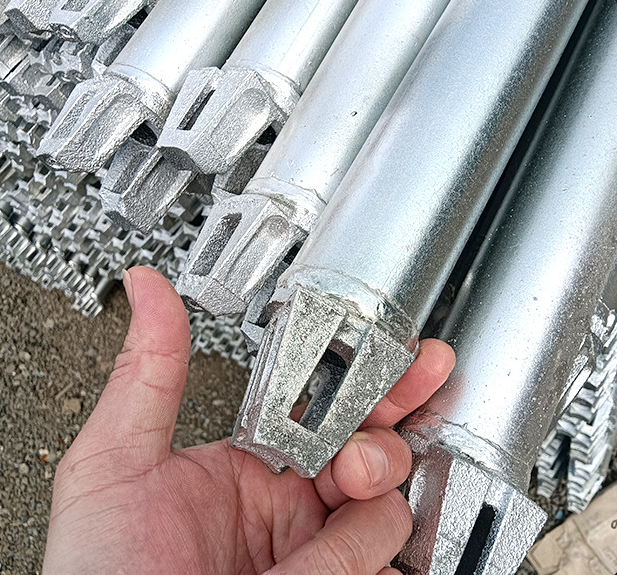
The mechanics of the central node define the system's flexibility and structural capability. Unlike traditional frame scaffolding, which forces a rigid 90-degree rectangular build, modular nodes allow horizontal members to be set in a nearly 360-degree fashion around the vertical posts. This multi-directional load transfer provides a massive engineering advantage on complex sites.
When navigating circular storage tanks, irregular building facades, or complex industrial pipework, scaffolders can angle the ledgers to follow the exact contour of the structure. The node acts as a central hub, distributing the load evenly down the vertical standard regardless of the angle of the incoming horizontal member. This eliminates the need for awkward tube-and-clamp cantilevers or unsafe bridging techniques when dealing with non-linear architecture.
Fixed connection points, typically spaced every 500mm along the vertical standard, eliminate the guesswork associated with traditional scaffolding. Pre-measured components remove the need for manual measuring and leveling on-site. When a scaffolder locks a ledger between two standards, the fixed length of the ledger and the fixed height of the nodes ensure the structure is perfectly square and plumb by design.
This standardization drastically reduces erection time. Scaffolders do not need to pause to check their work with a level constantly; the geometry of the components dictates the accuracy of the build. Furthermore, this fixed-interval design allows structural engineers to calculate load capacities with absolute certainty, as the node spacing and unbraced lengths are constant and predictable.
Industrial-grade system scaffolding relies on sturdy tubing construction engineered to withstand massive compressive and tensile forces. The physical dimensions and material chemistry are strictly controlled during manufacturing to ensure consistent performance across thousands of components.
Tubing Dimensions: The standard outer diameter is universally 48.3mm, allowing compatibility with standard scaffold couplers when necessary. Wall thickness typically ranges from 3.2mm for standard use to 4.0mm for heavy-duty shoring applications.
Steel Chemistry: Manufacturers utilize high-tensile, low-alloy structural steel, commonly Q345 or equivalent grades. This provides a superior strength-to-weight ratio compared to standard Q235 steel, allowing the scaffold to carry heavier loads without increasing the physical weight of the components.
Welding Standards: Node attachments are secured using automated MIG welding processes, ensuring deep penetration and consistent weld beads that resist cracking under dynamic loads.
Protective Finishes: Components undergo hot-dip galvanization. The steel is submerged in molten zinc, creating a metallurgical bond that coats both the inside and outside of the tubing. This finish, applied to a minimum thickness of 80 microns, prevents environmental degradation and maximizes lifecycle longevity in harsh marine or chemical environments.
The Ringlock Scaffolding System has become the industry benchmark for heavy-duty applications due to its superior node architecture. The rosette is a stamped steel plate, typically 9mm or 10mm thick, welded directly to the vertical standard at 500mm intervals.
The rosette design features eight distinct cutouts. Four small holes are positioned at 90-degree angles, dictating the primary square or rectangular grid of the scaffold. Four larger slots are positioned between the small holes, allowing for variable angle connections and the attachment of diagonal bracing. This specific configuration optimizes structural versatility, enabling scaffolders to build complex geometries, circular towers, and angled birdcages without compromising the primary load capacity of the vertical standards.
Structural shear resistance is vital for any tall or heavily loaded scaffold. Without proper bracing, a scaffold is susceptible to lateral sway, twisting, and catastrophic collapse under wind or live loads. The Ringlock Diagonal Brace provides this critical function, locking the rectangular bays into rigid triangles.
The brace features swivel heads at both ends, equipped with captive wedges. These heads slot into the large holes on the rosette. When the wedge is hammered home, it creates a rigid, non-slip connection that efficiently transfers lateral forces down through the node, into the vertical standard, and ultimately down to the base jacks. The precise length of the brace ensures that the scaffold bay is pulled perfectly square, maintaining the structural integrity of the entire build.
The captive wedge system utilized in Ringlock eliminates loose fittings entirely. The ledger ends feature a cast steel head with a vertical slot. A steel wedge is permanently housed within this slot. To make a connection, the scaffolder slides the ledger head over the rosette and drops the wedge through the corresponding hole.
This mechanism simplifies visual inspection drastically. A properly seated and hammered wedge provides immediate visual and physical confirmation of a secure, load-bearing joint. Site supervisors can walk the scaffold and instantly identify any unhammered wedges, significantly enhancing site safety and reducing the time required for pre-use inspections.
Time-motion analyses consistently show that system scaffolding erection times are significantly faster than tube-and-clamp methods. Erecting a standard 10m x 10m x 10m independent tied scaffold using modular components takes a fraction of the man-hours required for traditional methods.
The foolproof, self-aligning connections reduce the need for highly skilled scaffolders for basic erection tasks. While a competent supervisor must oversee the build, the actual physical assembly can be executed rapidly by a smaller crew. The elimination of manual measuring, leveling, and bolt-tightening allows the crew to maintain a continuous, fast-paced workflow, directly impacting project schedules and reducing overall labor budgets.
System scaffolding performs exceptionally well when site conditions deviate from standard flat facades. The modular nature allows for rapid adaptation around obstacles, curved structures, and suspended applications.
The vertical standards can easily accommodate heavy-duty caster wheels with locking brakes. By utilizing standard ledgers and diagonal braces, crews can quickly assemble stable, fast-to-deploy mobile scaffolding towers for maintenance or ceiling work. Furthermore, specialized components like cantilever brackets, bridging ledgers, and truss trusses integrate seamlessly into the rosette nodes. This allows scaffolders to build out over voids or step the scaffold out to follow building contours without compromising the primary load path or requiring complex engineering workarounds.
Logistical efficiency is a major operational advantage of modular systems. Uniform component sizes ensure high stackability and standardized palletization. Ledgers, standards, and braces fit perfectly into steel stillages, maximizing truck bed space and reducing transportation costs.
Component | Standard Lengths | Storage Method | Logistical Advantage |
|---|---|---|---|
Vertical Standards | 1.0m, 1.5m, 2.0m, 3.0m | Steel Stillages (Square stacking) | High density per truckload, easy crane lifting |
Horizontal Ledgers | 0.73m, 1.09m, 1.57m, 2.07m, 2.57m, 3.07m | Steel Stillages (Interlocking) | Prevents rolling, exact counts per bin |
Diagonal Braces | Varies based on bay size | Bundled or Stillaged | Uniform lengths simplify yard sorting |
Base Jacks | 0.6m, 0.8m | Wire mesh bins | Keeps threaded components protected |
Standardized parts reduce the risk of missing components delaying site work. When a truck arrives, site managers know exactly how many bays can be built based on the manifest. This uniformity simplifies yard audits, shipping manifests, and overall inventory management, preventing the common issue of having mismatched or unusable loose tubes cluttering the yard.
Eliminating loose fittings like couplers and bolts directly reduces dropping hazards. In traditional scaffolding, a dropped spanner or loose coupler poses a severe risk to workers below. Modular systems utilize captive wedges and integrated heads, meaning there are no small parts to drop during assembly or dismantling.
The connections act as "fail-safe" mechanisms. When a scaffolder places a ledger onto a rosette and drops the wedge, gravity holds the component in place. Even before the final hammer blow secures the joint, the ledger cannot fall out of the node. This allows the scaffolder to safely position themselves and prepare for the final securing strike without holding the component's weight, drastically reducing fatigue and assembly mistakes.
The structural characteristics of system scaffolding align perfectly with rigorous international standards, including OSHA regulations in the United States, ANSI guidelines, and the EN 12810/12811 standards in Europe. Reputable manufacturers subject their components to exhaustive destructive testing to determine exact failure points and safe working loads.
This manufacturer load data provides predictable structural performance. Structural engineers can design complex scaffolds, heavy-duty shoring towers, and suspended platforms with high confidence. They know exactly how much axial load a 3.0m standard can take and exactly how much shear force a diagonal brace can resist. This predictability is impossible to achieve with traditional tube and clamp, where the strength of the joint relies entirely on the torque applied by the individual scaffolder.
The primary risk associated with modular systems is mixing components from different manufacturers. While two different Ringlock systems may look identical to the naked eye, micro-tolerances in the rosette geometry, wedge angles, and steel grades exist.
Mixing parts from different foundries can result in wedges that do not seat properly, ledgers that sit at slight angles, and nodes that fail under lower-than-expected loads. More importantly, mixing components instantly voids the engineering certifications and manufacturer warranties. Strict procurement guidelines, single-source supplier contracts, and rigorous yard inspections are essential mitigation strategies to ensure that only compatible, certified components are sent to the job site.
When comparing system scaffolding to tube and clamp, the trade-off is ultimate flexibility versus speed and load capacity. Tube and clamp can navigate almost any obstacle, snake through dense pipework, and adapt to completely irregular shapes. However, the labor costs are prohibitive, and the erection speed is incredibly slow.
System scaffolding wins on the vast majority of commercial and industrial projects. The rapid assembly, guaranteed plumbness, and high load capacities offset the slight reduction in micro-flexibility. For straight runs, circular tanks, and standard industrial maintenance, modular systems provide a vastly superior return on investment regarding labor hours saved.
Frame scaffolding offers simplicity for flat, low-level facades. It is lightweight and easy to erect for basic stucco or painting work. However, it lacks adaptability. You cannot easily step a frame scaffold around a protruding balcony, nor can you easily build a circular tower.
System scaffolding provides the heavy-duty capacity and multi-directional flexibility required for industrial environments or complex architectural work. Frame is sufficient for basic, straight-line masonry, but system scaffolding is the clear, mandatory choice for demanding projects requiring high load capacities, complex bracing, and strict engineering oversight.
Audit your current project portfolio to identify structures with complex geometries or heavy load requirements that warrant an immediate upgrade to modular scaffolding systems.
Request certified load testing data, material mill certificates, and galvanization reports from potential scaffolding suppliers before finalizing any procurement contracts.
Consult with a structural engineer to map out base bay configurations, node spacing, and diagonal bracing requirements for your next heavy-duty industrial site.
Establish a strict single-source procurement policy to prevent the dangerous mixing of incompatible modular components within your storage yards and active job sites.
A: System scaffolding features a modular design with prefabricated components, fixed connection nodes, and high load capacity. It utilizes sturdy steel tubing and allows horizontal members to connect in a nearly 360-degree fashion around vertical posts, ensuring rapid, plumb assembly.
A: The Ringlock system utilizes a central rosette node that allows up to eight connections per level. It employs a captive wedge system for rapid, high-capacity locking, making it the global standard for heavy-duty industrial and offshore applications.
A: The Ringlock Diagonal Brace provides essential lateral stability and shear resistance. It prevents structural sway, maintains bay squareness, and safely transfers wind or live loads down through the nodes to the ground.
A: Pre-measured components and wedge-lock nodes eliminate the need for manual measuring, leveling, and tightening of individual loose couplers. The fixed intervals force the scaffold into a plumb and square configuration automatically.
A: No. Mixing components is strongly advised against. Slight variations in steel grade, wedge angles, or node geometry can compromise load capacity, create unsafe joints, and immediately void safety certifications and manufacturer warranties.


