


Tel: +86-131-8042-1118
E-mail:
E-mail:
26 Huanghai Road, Leting Economic Development Zone, Hebei Province, China


Views: 0 Author: Site Editor Publish Time: 2026-06-21 Origin: Site


Every commercial construction project eventually faces a vital access challenge. Reaching high elevations safely requires robust structural support. Choosing the wrong framework often leads to frustrating project delays. You also face inflated labor costs during assembly and dismantling. Furthermore, poor structural choices introduce severe OSHA compliance risks. We must transition beyond simple definitions.
You need to understand how specific categories align with your exact demands. We will evaluate load requirements, complex site geometry, and tight project timelines. This guide provides a definitive breakdown of access categories. You will gain a practical decision-making framework. Procurement managers and site engineers can use this guidance to optimize resources. By the end, you will know exactly how to match the equipment to your unique structural needs.
Scaffolding fundamentally breaks down into three primary categories: supported, suspended, and mobile/rolling.
Within supported structures, modular scaffolding—specifically the Ringlock scaffolding system—offers the highest balance of load capacity and rapid assembly.
Overall project expenditure depends more on labor hours required for erection and dismantling than on the initial material rental or purchase price.
Strict adherence to OSHA duty ratings (Light, Medium, Heavy) dictates which system is legally and physically viable for your specific trade requirements.
We must establish a high-level taxonomy first. You need this baseline before drilling into specific component designs. The industry classifies these frameworks based on how they distribute weight. We generally divide them into three primary groups.
Crews build these structures from the ground up using rigid metal supports. They utilize upright posts, horizontal bearers, and sturdy platforms. You will find this setup in roughly 90 percent of commercial construction sites.
Implementing them requires careful ground preparation. You need a highly stable, level foundation. Workers must utilize base plates and mudsills to distribute the heavy load. If the ground settles unevenly, the entire structure becomes dangerously unstable.
Suspended frameworks do not touch the ground. Crews hang them from the roof or upper floor levels. They rely on heavy-duty wire ropes and secure overhead rigging mechanisms.
You should deploy these for specific high-altitude tasks. They represent the best use case for high-rise window washing. They also excel during exterior skyscraper restorations. You typically use them when ground access is restricted or completely unavailable.
These resemble supported structures. However, manufacturers mount them on heavy-duty locking casters. Workers can manually push them across flat surfaces to reach multiple zones quickly.
You must observe strict limitation notes here. OSHA heavily regulates the height-to-base ratio. The standard requires a maximum 4:1 ratio to prevent tipping during movement. You can never move these towers while workers remain on the platform.
We often compare the two dominant approaches to supported systems. You must evaluate them based on labor efficiency and spatial adaptability. The right choice heavily impacts your bottom line.
Traditional frameworks utilize bare steel or aluminum tubes. Crews connect them using variable metal couplers. You cut the tubes to specific lengths as needed on the site.
They offer infinite adjustability. This makes them ideal for complex, irregular geometries. You will often see them wrapping around industrial refinery pipes. They also work well around delicate historical facades.
However, they carry significant risks. Assembly is exceptionally labor-intensive. Structural integrity depends entirely on the individual skill of the erector. An inexperienced worker can easily compromise the entire tower.
Modular frameworks use prefabricated components. They feature fixed connection points spaced at standardized vertical intervals. You lock the ledgers and transoms into these pre-measured nodes.
This standardization provides highly reliable load-bearing calculations. It drastically reduces erection time. You save considerable labor costs on massive job sites.
You should evaluate several sub-types. Cuplock works exceptionally well for long, straight building facades. Kwikstage remains highly popular in markets utilizing timber scaffolding boards. You must select the sub-type based on your primary building materials.
Evaluation Feature | Tube and Clamp | Modular / System Scaffolding |
|---|---|---|
Component Design | Loose tubes and variable couplers | Prefabricated units with fixed nodes |
Flexibility | Extremely high; fits any shape | Moderate; restricted by fixed intervals |
Assembly Speed | Slow and labor-intensive | Highly efficient and rapid |
Skill Requirement | Requires highly trained experts | Easier to assemble with basic training |
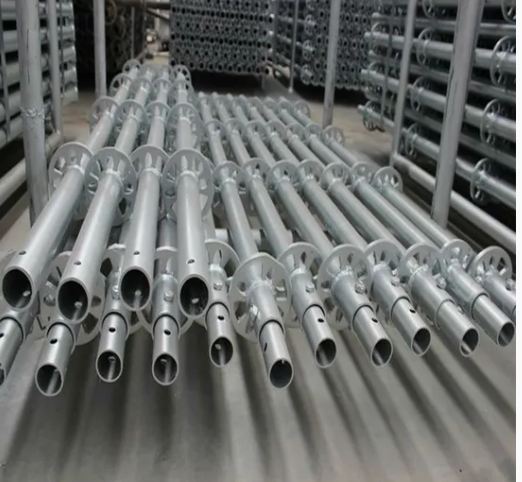
We must take a deep dive into the current industry standard. Complex modular builds require massive strength. The Ringlock Scaffolding System dominates heavy-duty commercial environments today.
This framework relies on advanced structural engineering. It utilizes a central rosette node welded onto the vertical standards. This unique design allows up to eight connections per point. You get four fixed orthogonal angles and four variable diagonal angles.
You lock the horizontal ledgers using an integrated wedge-lock mechanism. A quick hammer strike drives the wedge firmly into the rosette. This entirely eliminates the need for loose, separate fittings. You avoid lost-material costs common on chaotic job sites.
Consider these mechanical benefits:
High tensile steel construction resists severe bending forces.
Simultaneous multi-directional connections provide unparalleled rigidity.
Integrated locking pins prevent accidental dislodgement during harsh weather.
You must balance the marketing claims with actual procurement realities. The primary advantage is undeniable speed. Crews assemble it up to 30 to 50 percent faster than tube and clamp methods. You significantly lower your skilled labor hours.
However, we must add a skeptical consideration. You face a higher upfront capital expenditure for materials. It costs noticeably more than basic frame structures. You realize the best return on investment during long-term operations. It also pays off rapidly on multi-phase projects featuring complex architectural elements.
Procurement and project managers need a bottom-of-funnel selection matrix. You cannot guess when specifying structural support. You must analyze three critical dimensions to select the optimal Scaffolding System.
You must begin your selection process by consulting OSHA duty ratings. These legal classifications dictate exactly what a platform can support. Ignoring these metrics guarantees catastrophic failure.
Light Duty (25 psf): This rating supports personnel and basic hand tools. You use it for painting, minor repairs, or basic maintenance. Standard frame structures usually suffice here.
Medium Duty (50 psf): This rating handles personnel plus heavy construction materials. You need it for bricklaying, extensive plastering, and drywall installation.
Heavy Duty (75+ psf): This extreme rating supports dense masonry and heavy industrial equipment. You absolutely require robust modular systems like Ringlock to meet this standard safely.
You must evaluate ground leveling requirements thoroughly. Assess the presence of permanent obstacles like HVAC units or sloped embankments. Standard frames struggle heavily on steep inclines.
You should also assess the building perimeter. Determine if the structure must wrap around circular water tanks. Check for jagged corners or uneven architectural elevations. Traditional tube methods or flexible modular rosettes handle these spatial complexities best.
We recommend a strict financial framework. Do not evaluate your options based purely on daily material rental rates. You must aggressively factor in the hourly rate of your erection crews.
A cheaper standard frame might look attractive on a rental invoice. However, it might cost double in skilled labor hours. If the site requires constant modifications and adjustments, cheap materials quickly drain your labor budget. High-quality modular units offset their rental premium through blazing-fast assembly.
Demonstrating authority requires addressing regulatory realities. Deploying heavy metal structures overhead introduces massive liability. You must implement strict controls to protect your workers and your business.
The federal government strictly regulates these deployments. OSHA 1926 Subpart L dictates non-negotiable safety standards. You must ensure plumb and perfectly level construction.
You must utilize adequate base plates and heavy mudsills. Bare metal posts can never rest directly on soil. Furthermore, you face mandatory fall protection rules. Any platform exceeding 10 feet in height requires comprehensive guardrails. Alternatively, you must provide personal fall arrest systems for every exposed worker.
We must issue a severe warning regarding inventory management. You might feel tempted to combine parts from different manufacturers. You might also try mixing distinct types of connections.
Doing this immediately voids all published load capacity charts. It cancels the original engineering certifications. You assume total liability for any structural collapse. You can only mix parts if a certified, competent person explicitly approves the specific hybrid assembly in writing.
You must designate a formal "Competent Person" for the job site. This individual holds specific training and authority. They must conduct rigorous pre-shift inspections every single morning.
They utilize a standardized tagging system. A Green tag indicates complete safety for all trades. A Yellow tag means the platform is modified; workers must wear safety harnesses. A Red tag explicitly bans all use during active erection or dismantling. You cannot bypass these visual safety protocols.
Selecting the right structural support remains a strict mathematical calculation. You must weigh exact load demands against spatial complexity. You then filter those physical realities through local labor economics.
Your shortlisting logic should follow a clear path. Start with duty rating requirements to eliminate weak, inappropriate frameworks immediately. Next, assess your architectural complexity to choose between basic frames and advanced modular systems. Finally, calculate your expected labor hours versus your material budget to find the true project cost.
Take action before your project breaks ground. Consult with a certified structural provider or a dedicated access engineer. Ask them to run precise load calculations. You should verify these metrics before finalizing any rental agreement or purchase contract.
A: The choice depends heavily on the project scale. Heavy commercial and industrial projects predominantly use modular structures like Ringlock due to their massive load capacities. Light residential jobs typically rely on basic tubular frame variants for quick, low-cost deployment.
A: You should avoid this practice entirely. Mixing components from different manufacturers or different structural types voids original engineering certifications. It creates unpredictable stress points. You may only combine systems if a certified engineer explicitly approves the hybrid design in writing.
A: You must calculate the maximum intended load. Combine the total weight of all workers, their hand tools, and any stacked construction materials. Divide this total weight by the square footage of the platform. This yields your pounds per square foot (psf) requirement.
A: Modular systems consistently offer the fastest assembly speeds. They utilize prefabricated nodes and wedge-lock mechanisms. Workers simply lock the horizontal ledgers into fixed rosette points. This completely eliminates the tedious measuring and bolting required by traditional tube and clamp methods.


