


Tel: +86-131-8042-1118
E-mail:
E-mail:
26 Huanghai Road, Leting Economic Development Zone, Hebei Province, China


Views: 0 Author: Site Editor Publish Time: 2026-07-05 Origin: Site


The structural integrity of any temporary construction works relies heavily on more than just tubes or boards. It depends entirely on the quality and correct application of Scaffolding Fittings. Many contractors overlook these small but critical connections. When you use incompatible, uncertified, or incorrect fitting types, your project suffers. Poor choices lead to immediate schedule delays. They trigger severe safety compliance failures. Ultimately, they increase your overall project liability. We designed this guide for project managers, procurement officers, and site engineers. You need an evidence-based framework to make safe, efficient purchasing decisions. In this article, you will learn how to properly evaluate and categorize these critical components. We will show you how to select the right components for highly complex builds. By the end, you will understand exactly how to secure your framework and protect your workforce efficiently.
Drop-forged fittings offer higher load-bearing capacities and longevity compared to pressed steel alternatives in heavy-duty applications.
Selecting the right coupler (e.g., right-angle vs. swivel) dictates the structural rigidity and load distribution of the scaffold framework.
Modern construction projects are increasingly transitioning from traditional tube-and-fitting setups to modular solutions like the Ringlock Scaffolding System to reduce labor costs and assembly errors.
Procurement evaluation must prioritize compliance with established international standards (e.g., BS 1139, EN 74) over initial unit cost.
Fittings serve as the primary points of stress concentration. Every ounce of weight travels through these small metal joints. A single failing coupler can compromise the entire scaffold load path. Gravity and wind shear push heavily against the framework. The connections must resist these dynamic forces constantly. If one node slips, the adjacent nodes take on sudden, uncalculated loads. This chain reaction often leads to catastrophic structural collapse.
You must establish strict success criteria for your components. A fitting is only "project-ready" when it meets three distinct benchmarks. First, it requires clear manufacturer traceability. You should easily identify the production batch. Second, it needs verifiable load ratings. Certificates must prove its capacity. Third, it demands robust corrosion resistance. Rusty components lose their structural integrity rapidly.
Understanding the material baseline helps you make safer choices. Manufacturers typically produce these parts from either drop-forged steel or pressed steel. Drop-forged steel provides higher tensile strength. The forging process aligns the metal grain structure. It creates an incredibly impact-resistant component. These heavy-duty options withstand rigorous site handling. Pressed steel offers a cost-effective alternative. Factories stamp out these parts from flat steel sheets. They work perfectly for lighter, static loads. You should match the material to your specific project demands.
Selecting the correct clamp determines your project outcome. Each component serves a very specific structural purpose. Misusing them creates immediate safety hazards. Below, we break down the core categories.
This component serves as the backbone of your structure. It connects tubes at a fixed 90-degree angle. You rely on it as the primary load-bearing connection. Its grip prevents vertical slippage under heavy weight.
Function: Locks two intersecting tubes into a rigid, perpendicular grid.
Use Case: Bracing ledgers to vertical standards. You need them to establish absolute base rigidity.
Best Practice: Always check the internal grip threads before installation. Worn threads reduce gripping force significantly.
Not all building facades feature straight lines. Swivel couplers adapt to complex geometries. They feature a centralized rotating pin connecting two separate clamps. You can adjust the angle freely.
Function: Connects tubes at any required angle for diagonal support.
Use Case: Installing diagonal cross-bracing for sway prevention. They adapt easily to non-standard building shapes.
Warning: Never use them for primary vertical load bearing. The rotating pin acts as a weak point under direct downward stress.
You use these specifically for horizontal platform support. They attach secondary horizontal tubes to the main ledgers.
Function: Secures putlogs or transoms directly to horizontal ledgers.
Use Case: Creating a stable grid to lay walking boards across.
Limitation Warning: They are not designed to carry primary vertical loads. Use them strictly for board support. Overloading them causes immediate platform failure.
Projects frequently require height extensions. You need secure ways to join two tubes end-to-end.
Function: Connects two tubes linearly to extend total height or run length.
Evaluation Note: Sleeve couplers wrap around the outside of the tubes. They provide excellent tension and bending resistance. Joint pins slide inside the hollow tubes. They strictly align tubes for internal compressive loads. Do not use joint pins where tension forces exist.
Your foundation dictates the stability of everything built above it. Standards cannot rest directly on bare soil or concrete.
Function: Distributes the intense point load of the vertical standard evenly into the ground.
Use Case: Fixed base plates work well on perfectly level, solid surfaces. Adjustable screw jacks compensate for uneven terrain. They allow you to level the base structure millimeter by millimeter.
Summary Chart: Fitting Types and Load Functions | ||
Fitting Category | Primary Load Type | Key Structural Role |
|---|---|---|
Right-Angle Coupler | Vertical / Shear Load | Creates rigid 90-degree skeleton framework. |
Swivel Coupler | Tension / Compression | Provides diagonal sway and wind resistance. |
Putlog Coupler | Light Vertical Load | Supports walking boards and working platforms. |
Sleeve Coupler | Bending / Tension | Secures end-to-end external tube extensions. |
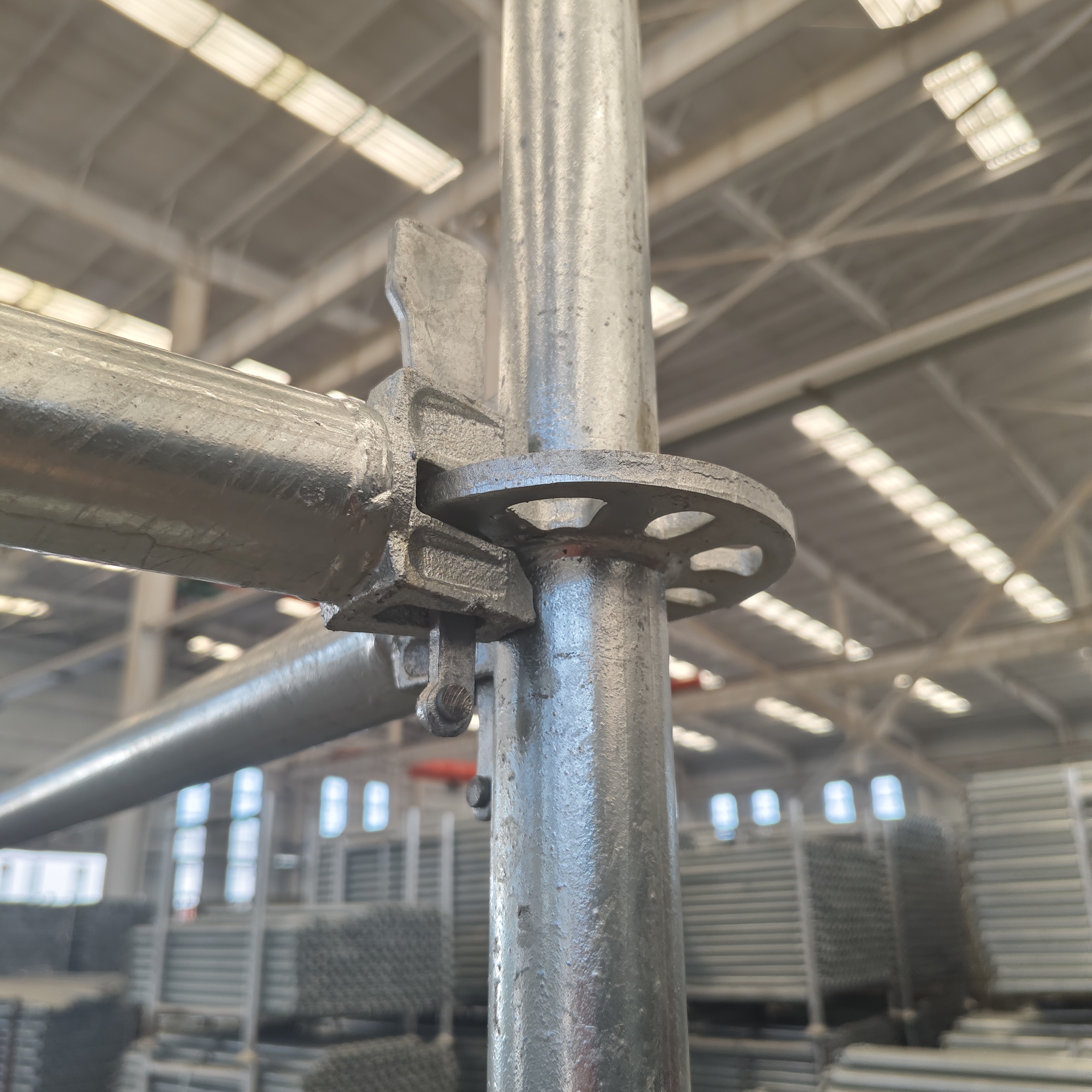
The industry constantly seeks better efficiency. We must evaluate traditional methods against modern advancements. Traditional loose components offer unparalleled flexibility. You can place a coupler anywhere along a tube. This allows you to build around complex, unpredictable obstacles. However, this flexibility requires highly skilled labor. It also increases assembly time and inspection difficulty.
Modular systems change this dynamic entirely. The Ringlock Scaffolding System represents a massive leap in erection speed. It replaces multiple loose couplers with a fixed rosette-and-wedge mechanism. You simply slide the wedge head into the rosette and strike it firmly. This eliminates the need for torque wrenches. It removes the guesswork from tightening bolts. The nodes are pre-measured and welded at fixed intervals. This guarantees perfect geometry every time.
You need a clear decision matrix to choose between these approaches. Neither system fits every single scenario perfectly. Evaluate your project constraints carefully before committing.
Decision Matrix: Traditional vs. Modular Systems | ||
Project Parameter | When to Use Loose Fittings | When to Use Ringlock Systems |
|---|---|---|
Structural Complexity | Highly irregular structures, heritage restorations. | Standardized, high-volume commercial builds. |
Labor Constraints | When skilled scaffolding labor is abundant. | When strict labor-time constraints exist. |
Adjustment Needs | Sites requiring constant micro-adjustments. | Projects requiring high repeatability. |
Inspection Speed | Slower (requires checking individual torques). | Faster (fewer loose components to inspect). |
Procurement teams face intense pressure to reduce expenses. However, you cannot compromise on foundational safety. You must evaluate suppliers based on strict engineering dimensions.
Standard compliance is your first line of defense. Emphasize the absolute necessity of verifying EN 74 or BS 1139 markings. These are not merely suggestions. They are rigorous testing frameworks. EN 74, for instance, dictates exact slip resistance tests. You should physically check components for manufacturer traceability stamps. Reputable factories stamp their logo and the standard directly into the metal. If a part lacks these markings, reject it immediately.
Corrosion protection directly impacts equipment lifespan. You must choose between Hot-Dip Galvanization and Zinc Plating. Hot-Dip Galvanization immerses the steel in molten zinc. It creates a thick, durable bonded layer. You should specify this for harsh environments and coastal projects. Zinc Plating uses an electro-galvanized process. It leaves a much thinner coating. It works acceptably for standard, dry environments. Hot-dip options cost more upfront but survive years of abuse.
Slip resistance and torque tolerances form your safety margin. The specific design of the clamp's inner hinge impacts its slip limits. Cheaply cast components often lack the proper inner friction ridges. We must highlight the danger of buying based solely on price. If a cheaper component's torque tolerances do not align with site safety factors, it will fail. You risk catastrophic slippage under heavy wind loads.
Even the best components fail if installed incorrectly. Site engineers must watch for common human errors. Establishing robust protocols prevents minor mistakes from becoming major disasters.
Over-Tightening and Under-Tightening: Torque-wrench misuse happens daily. Workers often over-tighten bolts to feel secure. This strips the threads and compromises the clamp's integrity. Conversely, under-tightened loose nuts lead to immediate tube slippage. You must train crews to use calibrated tools.
Mixing Manufacturer Tolerances: Companies often mix disparate brands of equipment to save money. This creates massive engineering risks. Thread pitches or tube grips may slightly mismatch between brands. Even a one-millimeter difference reduces the clamping force drastically. Stick to a single, verified manufacturer for load-bearing nodes.
Inspection Maintenance Failures: Equipment degradation is a harsh reality. Parts rust, bend, and warp. You need protocols for identifying deformed drop-forged caps. Crews must spot rusted T-bolts before re-circulation. Throwing damaged items back into the storage bin guarantees a future failure. Quarantine broken parts immediately.
You need a structured approach to configure your project correctly. Bypassing these steps leads to structural inadequacy or budget blowouts.
Step 1: Load Class Assessment
Determine the specific duty rating of the project. Are you building light access platforms for painters? Or do you need heavy shoring for masonry and concrete pours? Heavy duty ratings require dense grid spacing and forged components. Calculate the live and dead loads before ordering parts.
Step 2: Labor vs. Material Cost Calculation
Evaluate your true financial exposure. Weigh the upfront cost of advanced modular systems against your ongoing labor expenses. Traditional couplers cost less per unit. However, tightening individual bolts eats hundreds of labor hours. Modular systems cost more initially but assemble rapidly. If your project faces tight deadlines, modular configurations usually win.
Step 3: Vendor Vetting
Never trust a sales brochure blindly. Request batch testing certificates from independent laboratories. Assess the vendor's ability to provide technical data sheets. Check their inventory depth. A good vendor supplies replacement components consistently without long lead times. Ask for load capacity charts signed by qualified engineers.
Proper specification of your connections mitigates severe safety risks. It prevents costly project bottlenecks before they begin. You cannot build a safe project on sub-standard joints. We explored how different materials, categories, and systems impact your site. Whether you use traditional clamps or modern rosette systems, quality remains paramount.
We encourage project planners to take immediate action. Audit your current inventory this week. Discard deformed or heavily rusted components. Consult with technical specialists to run a thorough load-requirement analysis before your next procurement cycle. Make evidence-based decisions, enforce strict site inspection routines, and keep your workforce secure.
A: EN 74 is the modern European standard focused heavily on rigorous testing procedures, including slip and failure tests. BS 1139 is an older British standard. While BS 1139 is still widely recognized in specific global regions, EN 74 provides updated, more stringent performance criteria for modern builds.
A: Not always. Drop-forged couplers offer superior strength, impact resistance, and durability. They are essential for heavy-duty applications. However, pressed steel couplers are fully compliant and highly cost-effective for lighter, non-critical static applications. Choose based on your required load class.
A: Yes, but with strict limitations. Standard tubes and specific couplers are often used to tie-in or brace Ringlock systems to complex facade points. However, you must ensure the core load-bearing nodes remain uniform. Do not substitute core modular components with loose parts.


