


Tel: +86-131-8042-1118
E-mail:
E-mail:
26 Huanghai Road, Leting Economic Development Zone, Hebei Province, China


Views: 0 Author: Site Editor Publish Time: 2026-07-09 Origin: Site


Selecting scaffolding components demands far more than just checking off a basic procurement list. It represents a critical structural engineering and site safety decision. Your crew's lives and your project timeline depend on this choice. Subpar materials or incorrect sizing inevitably lead to project delays. You risk failing stringent compliance audits and facing increased labor costs during assembly. A weak foundation compromises the entire structure.
We will explore how to properly evaluate and size the vertical backbone of these systems. You will learn to source a reliable ringlock scaffold standard for your specific worksite needs. This guide provides contractors and project managers with a clear, evidence-based framework. You can use these insights to guarantee structural safety and confidently manage your procurement strategy.
The vertical standard serves as the primary load-bearing element in any modular scaffolding structure. It dictates the overall height and carries the accumulated vertical weight down to the ground. This component features engineered rosettes welded at precisely fixed intervals. Manufacturers typically space these rosettes every 500mm along the tube length. This spacing provides predictable connection points for multi-directional ledgers and diagonal braces.
Size variations ensure contractors can adapt the system to different elevation requirements. The most common standard lengths include 0.5m, 1.0m, 1.5m, 2.0m, 2.5m, and 3.0m. Shorter lengths often serve as starter pieces or shoring supports. Longer standards allow for rapid vertical erection on building facades. Tube specifications strictly demand a 48.3mm outside diameter. The wall thickness usually sits at 3.2mm. Certain regional safety compliance requirements dictate alternatives like 3.0mm or 4.0mm tubes.
The rosette connection represents a brilliant piece of structural engineering. Each rosette features an 8-hole design optimized for rigidity. Four small holes accept right-angle ledgers perfectly aligned at 90 degrees. Four larger slotted holes accommodate diagonal braces at variable angles. Manufacturing precision at this junction strictly dictates the rigidity of the entire structure. Even a slight misalignment prevents the wedge pins from seating properly. A loose wedge pin creates a hinged joint instead of a fixed node. This drastically reduces the buckling resistance of the tower.
Steel grade selection directly dictates how much weight a scaffolding standard can safely support. High-yield structural steel provides the necessary strength for heavy-duty applications. Grade Q345 or S355 steel serves as the industry benchmark. We must contrast these high-yield materials against lower-grade alternatives like Q235. A standard built from Q235 steel yields much earlier under heavy axial compression. Yield strength measures the exact point where steel permanently deforms. Higher yield strength directly increases the standard's resistance to catastrophic buckling.
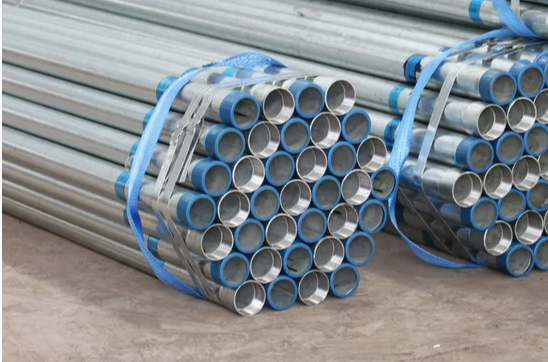
Surface protection remains equally critical for long-term structural safety. Galvanized steel pipe forms the non-negotiable baseline for longevity. Factories submerge the raw steel tubes into molten zinc at roughly 450 degrees Celsius. This hot-dip process creates a metallurgical bond. It typically leaves a minimum zinc coating thickness of 60-80 µm. This heavy-duty coating protects both the inside and outside of the tube. It proves mandatory for survival in harsh industrial or corrosive marine environments.
Contractors must actively avoid the false economy of inferior coatings. Painted standards degrade incredibly quickly. The abrasive wear of frequent assembly and dismantling chips the paint away. Moisture then penetrates the bare steel and causes rapid internal rusting. Electro-galvanized components offer only a microscopic zinc layer. This thin barrier vanishes after just a few rough impacts on the job site. Once corrosion attacks the standard, the tube wall thins out. A thinner tube wall immediately compromises the engineered load capacity.
Weld quality secures the connection between the high-yield tube and the rosette. Human welders often produce inconsistent penetration. Premium factories rely entirely on automated robotic welding. They execute full-penetration welds around the entire circumference of the rosette joint. Weak surface welds risk shearing under heavy dynamic loads. If a rosette shears off the tube, the attached ledgers fall. This triggers a progressive collapse of the surrounding framework.
Understanding weight limits requires looking beyond a single component. The safe load capacity of a Ringlock standard changes dynamically based on its unbraced length. The unbraced length equals the vertical distance between your ledger levels. A standard braced every 1.0m supports significantly more weight than one braced every 2.0m. Longer unbraced sections act like slender columns. Slender columns buckle outward much faster under compressive forces.
Suppliers often advertise high theoretical limits. You must evaluate these claims using transparent engineering assumptions. A manufacturer might state a theoretical leg load of 40kN. This impressive number is only valid under perfect conditions. It assumes the base ground holds firm without settling. It assumes diagonal bracing perfectly matches the engineering design. It also requires the ledgers to be installed exactly at the prescribed intervals. Missing braces or uneven base jacks instantly invalidate the 40kN rating.
Consider the typical capacity fluctuations based on ledger configurations.
Typical Permissible Axial Loads by Unbraced Length
| Unbraced Length (m) | Permissible Load (kN) - Q345 Steel | Buckling Risk Level |
|---|---|---|
| 1.0 | ~ 45 - 50 kN | Low |
| 1.5 | ~ 35 - 40 kN | Moderate |
| 2.0 | ~ 20 - 25 kN | High |
We must align our procurement standards with internationally recognized safety frameworks. The European EN 12810 and EN 12811 standards govern performance requirements strictly. They outline exact testing methods for stiffness and load resistance. OSHA scaffolding standards in the United States dictate similar safety margins. In Oceania, AS/NZS 1576 provides rigorous compliance benchmarks. Purchasing materials certified under these frameworks guarantees predictable structural performance. Uncertified materials introduce massive unknown variables into your engineering calculations.
Different project scopes demand distinct scaffolding setups. Selecting the right standard sizes optimizes both safety and labor efficiency. Let us break down three major construction applications and their respective configurations.
Procurement errors and site assembly mistakes often combine to cause catastrophic failures. Mismatched tolerances represent a severe implementation risk. Many contractors attempt to mix components from different manufacturers to save time. This practice introduces massive liability. A wedge-pin from Brand A might sit loosely inside a rosette from Brand B. Even a 1mm deviation in clearance ruins the rigidity. The entire structural tower will sway under wind loads.
Counterfeit or uncertified materials quietly infiltrate construction supply chains. Shady suppliers produce "lightweight" standards to undercut market prices. They achieve this by secretly reducing the tube wall thickness. They might supply a 2.7mm wall instead of the specified 3.2mm wall. You cannot spot this visually on a busy job site. This hidden defect drastically lowers the buckling threshold. A standard expected to hold 30kN might collapse at 18kN.
Assembly pitfalls happen constantly due to rushed schedules or poorly trained crews. We often observe common site errors during safety audits.
Securing reliable scaffolding requires a structured vetting process. You cannot evaluate a supplier simply by glancing at their marketing brochure. You must demand verifiable evidence of their manufacturing competence. Require suppliers to provide recent, independent lab test reports. Certificates from globally recognized bodies like SGS or TUV carry substantial weight. These reports must detail physical load testing results. They should also verify the chemical composition of the raw steel batch.
Factory Quality Control (QC) separates premium manufacturers from basic trading companies. Assess the supplier's internal QC protocols meticulously. Specifically, inquire about their non-destructive testing (NDT) capabilities. Excellent factories use ultrasonic testing on their robotic rosette welds. They also execute continuous galvanization thickness checks using digital micrometers. Consistent QC ensures the thousandth standard performs exactly like the first one.
Evaluate the supplier's engineering and logistics support. True partners offer custom engineering drawings for complex builds. They provide stamped load calculations tailored to your specific project needs. Reliable global shipping and inventory traceability are also paramount. You need assurance the materials will arrive intact and on schedule.
Your next steps should involve physical validation. Advise your procurement team to request physical samples before signing large contracts. Obtain a sample standard, a ledger, and a diagonal brace. Assemble the node in your own yard. Strike the wedge pin with a hammer. Check for excessive play in the joint. Measure the wall thickness with calipers. Confirming the quality firsthand protects your crew from theoretical promises.
The reliability of any ringlock system hinges entirely on its core vertical elements. You cannot compromise on the dimensional accuracy or the material strength of your standards. High-yield steel and robotic welding guarantee the parts will survive punishing site conditions. Proper galvanization ensures the equipment remains safe to use for many years.
To implement a safer scaffolding strategy, keep these final action steps in mind:
Take control of your site safety today. Contact your engineering or sales team to request project-specific load calculations. Ask them to conduct a comprehensive compliance audit of your current inventory. Alternatively, request a formal quote for certified, heavy-duty galvanized components.
A: Mixing components from different manufacturers introduces severe engineering risks and liability. Even minor dimensional variations in the rosettes or wedge pins cause loose connections. This looseness creates dangerous structural sway. We strongly discourage mixing brands unless a qualified engineer structurally certifies the cross-compatibility in writing.
A: Load capacity depends entirely on the unbraced length, which is determined by your ledger bracing intervals. A 2.0m standard braced every 1.0m carries far more weight than one braced every 2.0m. You must consult the manufacturer’s specific load charts and engineering data to determine the exact safe working load.
A: Hot-dip galvanized standards routinely offer a lifespan exceeding 10 years. The exact duration depends heavily on environmental exposure, handling methods, and routine maintenance. Coastal areas or chemical plants accelerate zinc depletion. Proper storage and avoiding severe impact damage will maximize the coating's protective life.

