


Tel: +86-131-8042-1118
E-mail:
E-mail:
26 Huanghai Road, Leting Economic Development Zone, Hebei Province, China


Views: 0 Author: Site Editor Publish Time: 2026-07-06 Origin: Site


Every towering modular scaffolding structure depends heavily on a robust central backbone. Engineers identify this vertical load-bearing core as the ringlock scaffold standard. Subpar standard components introduce severe structural vulnerabilities. They compromise physical integrity across active job sites. Weak vertical links cause unexpected compliance failures. They also drastically reduce your overall asset lifespan. You must address these hidden dangers before erecting complex industrial builds.
Our primary goal involves equipping project managers and procurement teams with a clear, actionable framework. We want to help you evaluate these vertical pillars technically and commercially prior to making capital investments. You will learn exactly how structural anatomy, engineering specifications, and strict manufacturing qualities secure modern temporary access structures. Understanding these elements ensures your upcoming builds remain safe, compliant, and highly efficient.
Understanding the fundamental geometry of these components helps managers appreciate their structural importance. Every individual part serves a specific mechanical purpose. When combined, they form an incredibly resilient framework.
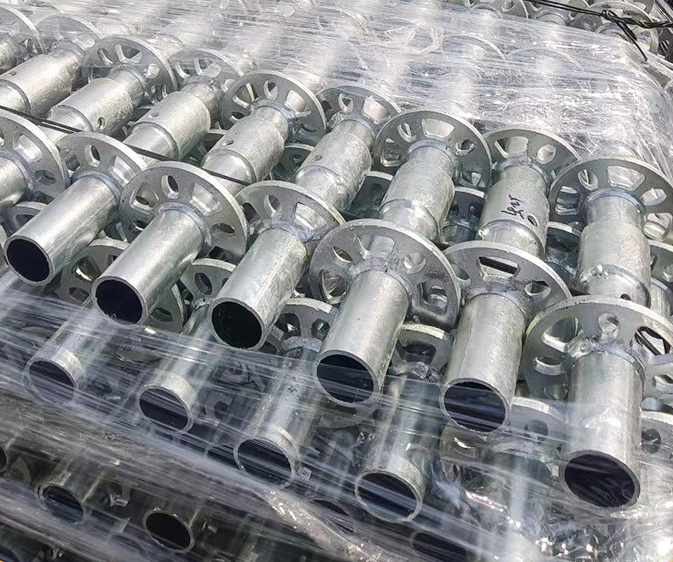
The foundational steel pipe serves as the primary load-bearing column. Manufacturers typically design this tube using a 48.3mm outer diameter. This specific dimension aligns perfectly across global scaffold standards. The vertical tube transfers immense gravitational forces straight down to the base jacks. A flawless tubular design prevents premature bending or localized buckling under heavy industrial loads.
Forged or stamped rosettes sit securely welded at precise 500mm intervals along the vertical tube. These rosettes feature a unique 8-hole design. Four small holes accept ledger connections at right angles. Four larger holes accommodate diagonal braces at various angles. This multidirectional capability allows builders to construct complex geometries. You can connect multiple components simultaneously without relying on traditional friction clamps.
Each standard includes a built-in top or bottom spigot. We often call this a connector pin. The spigot allows workers to stack standards vertically. It ensures continuous structural alignment. This internal sleeve creates a rigid load transfer path between the upper and lower tubes. Snug spigot tolerances prevent unwanted lateral swaying at the connection joints.
Individual parts do not function in isolation. They integrate perfectly to form a massive, unified grid. These synchronized components lock the entire Ringlock scaffolding system into a rigid, sway-resistant matrix. Proper integration guarantees safety across multi-level working platforms.
A safe site requires rigorous mathematical validation. Engineers calculate specific load limits based on metallurgical properties and component dimensions. You cannot guess load capacities when human lives are at risk.
Carbon steel grades vary significantly across the manufacturing industry. Basic carbon steel (like Q235) offers adequate strength for minor residential jobs. However, industrial applications demand high-strength structural steel like Q345 or S355. Higher yield strength directly dictates buckling resistance. When vertical loads increase, high-grade steel resists plastic deformation. This material superiority keeps tall structures standing during severe weather events.
Tube wall thickness plays a massive role in axial load capacity. The global market generally offers 3.0mm and 3.2mm specification variants. A mere 0.2mm difference seems negligible on paper. Yet, it drastically impacts the moment of inertia. Thicker walls significantly increase the total allowable load per leg. We recommend specifying 3.2mm high-yield tubes for heavy-duty industrial shoring applications.
Traditional tube-and-clamp systems rely entirely on friction to hold crossbars. If a clamp loosens, the connection fails. The rosette connection introduces a mechanical wedge-lock advantage. A steel wedge drives through the ledger head and the rosette hole. This creates a positive, physically interlocking joint. The rigid node minimizes microscopic movements. It actively prevents structure-wide sway.
You must base all site designs on recognized safety standards. Regional regulations demand strict compliance frameworks like EN 12810/12811 or ANSI/SSFI. These codes require rigorous engineering calculations. Manufacturers must validate their theoretical load assumptions through destructive physical testing. Always request certified load tables before finalizing procurement orders.
Structural Material Specification Impact
| Steel Grade | Wall Thickness | Buckling Resistance | Best Application |
|---|---|---|---|
| Q235 (Mild Steel) | 3.0 mm | Moderate | Light duty facade work |
| Q345 / S355 | 3.2 mm | Excellent | Heavy industrial shoring |
| Q345 / S355 | 3.0 mm | High | Standard commercial builds |
Procurement teams frequently compare modern modular systems against older technologies. Understanding these differences highlights why many contractors upgrade their scaffolding fleets. We evaluate these options based on geometry, labor efficiency, and overall safety.
Cuplock systems utilized a sliding top cup to secure ledger blades. It was revolutionary decades ago. However, the cuplock node usually limits connections to 90-degree orthogonal angles. Ringlock utilizes a fixed 8-directional rosette node. This newer design offers far superior adaptability. You can easily erect circular structures. You can build complex suspended platforms. The multidirectional rosettes accommodate curved industrial tanks effortlessly.
Tube and clamp systems remain highly flexible. However, they carry significant labor penalties and safety risks.
Visual inspections alone cannot determine product quality. You must analyze the manufacturing processes used by your supplier. Evaluating a premium Ringlock standard requires intense scrutiny of documentation and fabrication methods.
Manual welding introduces dangerous inconsistencies. An operator might leave microscopic pinholes or undercut the steel tube. Automated robotic welding around the rosette remains critical. Robots apply a continuous, even weld bead. This uniformity guarantees symmetrical load distribution. It actively prevents weld shear under extreme gravitational or lateral loads.
Scaffolding equipment lives outdoors. Moisture and oxygen rapidly degrade raw steel. You must demand hot-dip galvanization (HDG). The manufacturer submerges the fabricated standard into molten zinc. This process coats both the interior and exterior tube walls. A minimum zinc coating thickness of 60 to 80 microns is essential. Proper HDG secures a reliable 10 to 15-year operational lifespan.
Mixed-metal batches pose a massive threat to site safety. Unscrupulous suppliers might mix weak steel tubes among high-grade orders. Advise your buyers to demand verifiable Material Test Reports (MTRs). You should also require third-party batch testing certificates. Full traceability ensures every standard meets the exact yield strength promised during the sales process.
Modular systems require microscopic precision. If the outer diameter bulges slightly, the spigot will not slide in. We call this "system jamming". Conversely, if the rosette slots are cut too wide, the wedge will fit loosely. Loose connections destroy system rigidity. Strict engineering tolerances guarantee fast assembly and uncompromising structural stiffness.
Theory and manufacturing specs matter greatly. Yet, how these components perform in the dirt and mud dictates project success. Managers must address weight, storage, and cross-brand mixing risks.
We must acknowledge a core operational trade-off. Thicker, high-grade steel standards weigh significantly more than basic tubes. A 3.0m heavy-duty standard requires substantial physical effort to lift. Site managers must implement proper handling protocols. You should mandate mechanical lifting hoists or cranes for erecting tall structures. Pushing workers to manually lift heavy standards all day causes severe ergonomic injuries.
Scaffolding yards process thousands of metal pieces weekly. Managing operational reality means tracking standard lengths accurately. Manufacturers produce standards ranging from 0.5m to 3.0m. We highly recommend standardizing your fleet around just two or three primary lengths. Reducing size variations minimizes sorting time in the yard. Workers load trucks faster. Site crews locate the right pieces without searching through mixed stillages.
Contractors often try to mix rental components from different manufacturers to save money. We strictly warn against mixing standards across different brands without rigorous engineering sign-off. Minor geometric differences always exist between factories. A rosette might sit 2mm higher on Brand A compared to Brand B. These tiny mismatches alter the designed load behavior. More importantly, mixing brands instantly voids system warranties and shifts total liability onto the contractor.
The Ringlock scaffold standard represents far more than just a steel pipe. It operates as the highly engineered spine of a safe, compliant, and efficient work site. When you invest in quality vertical components, you protect your workers and your timelines. Reiterate to your procurement team that evaluating steel grade, robotic welding, and galvanization thickness remains the absolute key to maximizing long-term ROI. Do not compromise on the backbone of your scaffolding fleet.
Your next step requires proactive supplier evaluation. Encourage your engineering teams to request detailed technical specification sheets today. Ask your current vendors for updated structural load tables. Finally, schedule an engineering consultation to ensure you match the precise standard specifications directly to your upcoming project requirements.
A: The industry utilizes several standardized lengths to accommodate various heights. Common dimensions include 0.5m, 1.0m, 1.5m, 2.0m, 2.5m, and 3.0m. Planners select these lengths based on specific lift height requirements. Stacking a 2.0m and a 1.0m standard perfectly achieves a 3.0m platform elevation.
A: We strictly advise against cutting, drilling, or welding any standard on-site. Physical modifications destroy the protective zinc galvanization. Cutting alters the highly engineered load path and compromises structural integrity. Any unauthorized field modification immediately voids factory safety certifications and warranties.
A: The fixed 500mm rosette spacing creates a predictable, modular grid. This exact spacing allows for rapid, perfectly leveled ledger placement. It enables workers to install safety rails at compliant heights instantly. The fixed intervals eliminate manual measuring, drastically speeding up exact working platform construction.

