


Tel: +86-131-8042-1118
E-mail:
E-mail:
26 Huanghai Road, Leting Economic Development Zone, Hebei Province, China


Views: 0 Author: Site Editor Publish Time: 2026-07-03 Origin: Site


Scaffolding teams rely on modular systems for rapid assembly and extreme flexibility on busy job sites. However, overall structural stability relies entirely on the precise installation of the Ringlock diagonal brace. When you rush this critical installation step, you jeopardize the entire framework. Installation errors severely compromise vital load transfer pathways across the scaffold matrix. Such oversight directly leads to failed safety inspections, costly project delays, and potentially catastrophic structural sway during adverse weather conditions. You simply cannot afford to ignore these lateral risks on site. This guide will outline the most critical technical mistakes made during brace installation. We will provide evidence-based evaluation criteria to ensure safe assembly and smarter procurement. Read on to master structural compliance, improve your team workflow, and secure your next heavy-duty project.
Scaffolding failures carry severe consequences for any construction firm. We often overlook the hidden penalties of poor safety management. Stand-downs halt productivity immediately when inspectors find missing components. Rework labor drains your project budget faster than material costs. Furthermore, strict non-compliance penalties regarding OSHA and EN standards bring heavy financial fines. You lose both money and reputation when temporary structures fail regulatory audits.
Failure mechanics are straightforward but highly dangerous. Missing or poorly installed bracing disrupts intended load paths. It forces horizontal components, known as ledgers, to absorb shear forces. Manufacturers never engineered ledgers to handle lateral stress. Under such pressure, connections bend permanently. The rosette nodes begin to buckle under horizontal shear. Gravity combined with wind loads will quickly overwhelm an unbraced vertical standard.
What does structural success look like? A fully compliant scaffold operates as a unified rigid matrix. In this optimized state, diagonal braces seamlessly transfer wind and live loads down to the base jacks. We must treat the structure as one cohesive unit rather than a collection of loose pipes. Proper spatial rigidity guarantees worker safety during high-stress operations.
| Management Error | Direct Financial Cost | Structural Risk Consequence |
|---|---|---|
| Skipped safety inspections | Severe OSHA compliance fines | Undetected node vulnerabilities |
| Using deformed brace tubes | Frequent replacement purchases | Buckling under eccentric loads |
| Ignoring design blueprints | Massive rework labor expenses | Loss of total torsional rigidity |
Scaffolding geometries require exact matching on every single tier. You commit a major error when you attempt to install a brace designed for a specific bay length into a slightly different bay. For example, forcing a 2.0m brace into a 2.07m bay creates immediate mechanical problems. The mathematics simply do not align.
In reality, erectors face incredibly tight deadlines. They may force the wedge pin into the rosette using excessive hammering. This aggressive action permanently bends the cast brace head. Workers often believe they are simply tightening the joint. Instead, they are destroying the structural integrity of the casting.
The consequence compromises the entire bay immediately. This brute force introduces permanent pre-tension or pre-compression into the component. It happens before heavy live loads are even applied to the deck. You drastically reduce its overall load capacity. A pre-stressed tube will snap or buckle much faster than a neutral one during a storm.
Correction requires strict operational discipline. Implement a rigid pre-sorting protocol on site before assembly begins. Teams must match ledger geometry precisely against stamped dimensions on the brace. Follow these specific pre-assembly steps:
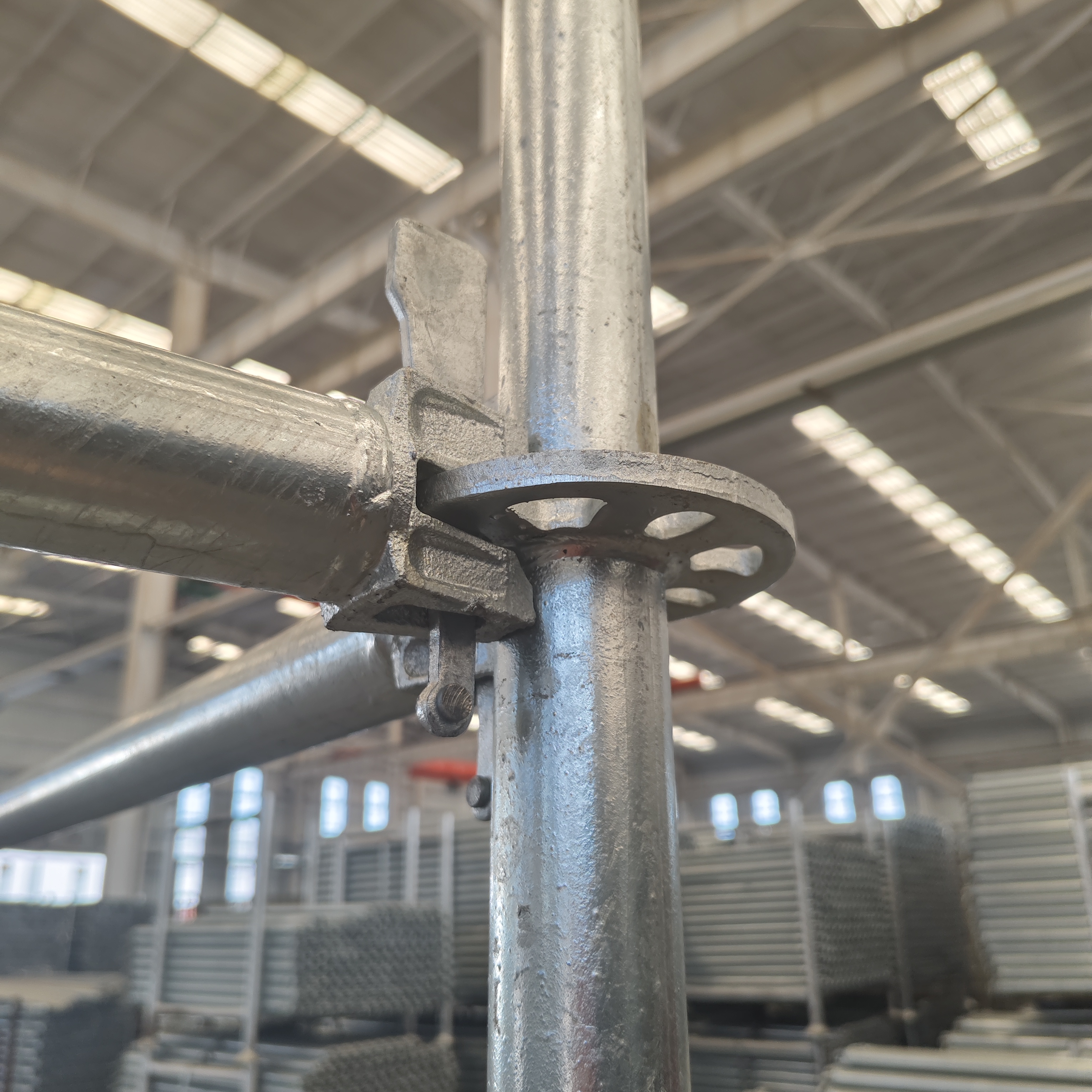
The rosette connection serves as the central node of the ringlock system. You fail compliance when you leave wedge pins merely "hand-tight." Workers must strike them to their specified locking depth. The wedge must bite into the steel to prevent upward dislodgement.
Rushed assembly often causes this dangerous reality. Erectors may misunderstand how ringlock rosette connections transfer physical load. They skip the final hammer blow to save a few seconds per node. Fatigue also plays a role during long shifts. Workers wielding heavy hammers might deliver weak strikes as the day ends.
Loose wedge pins allow dangerous micro-movements within the scaffolding node. We call this mechanical "play." Under dynamic loads like strong wind or heavy foot traffic, this vibration causes accelerated wear. The constant friction degrades the galvanized coating. Eventually, it leads to localized node failure and structural sagging.
You must correct this immediately through accountability. Establish standardized visual inspection protocols across all levels. Supervisors must verify every connection systematically. They need to ensure the wedge sits entirely flat against the rosette. You should see absolutely no visible gaps between the wedge collar and the ring.
| Inspection Status | Visual Indicator | Action Required |
|---|---|---|
| Proper Engagement | Wedge driven down securely, no gap present. | Approve node for load bearing. |
| Incomplete Engagement | Pin is loose, visible gap above the rosette. | Strike wedge with scaffold hammer immediately. |
| Damaged Wedge | Pin is bent, rusted, or jammed halfway. | Dismantle joint and replace the component entirely. |
Scaffolding layouts rely on mathematically precise engineering. You risk total collapse when skipping bracing bays to save assembly time. Altering the pattern to accommodate site obstacles without engineering approval is equally dangerous. Workers sometimes remove a lower brace to allow forklift access. They often forget to replace it.
Field modifications happen frequently in reality. However, diagonal braces must strictly follow specific patterns. Engineers dictate zigzag or continuous tower bracing based on the precise height-to-base ratio. A tall, narrow scaffold requires drastically different bracing than a low, wide facade framework. You cannot guess the correct layout.
The consequence of omission is severe. You suffer a massive loss of torsional rigidity. The scaffold suddenly becomes susceptible to buckling under eccentric loads. Without triangulation, the right angles of the ledgers and standards collapse into parallelograms. The structure simply folds onto itself.
To correct this culture, treat the scaffolding design drawing as an unalterable blueprint. You cannot treat it as a mere suggestion. Any omission requires formal sign-off. A qualified scaffolding engineer must approve every single modification. They will calculate the new load paths and specify alternative support mechanisms.
Mixing systems creates invisible hazards on your job site. You create critical vulnerabilities by mixing uncertified, third-party components with your primary system. Reliable Scaffolding fittings must match perfectly to function safely. Combining different brands often voids manufacturer warranties.
Procurement teams often source cheaper replacement parts. They aim to reduce upfront material expenses. Unfortunately, they ignore the precise manufacturing tolerances required for structural safety. A cheap brace might look identical to a premium one from afar. Up close, the metallurgy and casting dimensions differ wildly.
The consequence is a severely weakened structural matrix. Even slight millimeter differences in the brace head casting matter immensely. Variances in wedge thickness prevent a secure lock. When a heavy load strikes the frame, these mismatched nodes slip. They fail to distribute the kinetic energy evenly.
Correction demands uncompromising vendor consistency. You must ensure all fittings carry identical load certifications. Look for strict EN 12810 or EN 12811 testing standards. Always request verifiable batch testing documentation before approving a purchase. Do not mix and match components just to save a few dollars on freight.
Moving from field installation to office procurement requires deep focus. You must know exactly what to look for when shortlisting suppliers. Proper evaluation prevents structural failures before materials even arrive on your site. Establishing a strict baseline for quality saves massive headaches later. Let us break down the key evaluation dimensions.
Material quality comes first in any assessment. Always require Mill Test Certificates (MTCs) from your vendor. These official documents verify the use of high-yield steel grades. You should demand structural steel like Q345 or Q235. Low-grade steel will bend permanently under normal operational loads.
Manufacturing precision remains non-negotiable. Inspect the robotic welding quality closely. The critical junction sits between the hollow brace tube and the solid cast steel head. Manual welding often leaves inconsistent penetration. Robotic welding guarantees uniform strength across every single batch produced.
Corrosion protection ensures long-term longevity. Verify hot-dip galvanization standards on all steel parts. Check the minimum zinc coating thickness. It protects your investment in harsh environmental conditions. Salt air, industrial chemicals, and heavy rain will rapidly destroy ungalvanized steel.
Take actionable next steps today regarding your yard stock. Audit your current inventory thoroughly. Identify and isolate damaged braces. Look for bent tubes, cracked welds, or rusted wedges. Establish a strict vendor checklist before starting your next major procurement cycle.
The safety of a multi-ton scaffolding structure relies fully on the integrity of its diagonal bracing. You cannot compromise on these critical lateral connections. When you ignore proper geometry or wedge engagement, you invite disaster onto your site. Avoiding these critical installation mistakes requires highly disciplined action.
It takes a combination of strict field supervision and unyielding adherence to engineering blueprints. Standardized procurement practices further eliminate hidden component risks. You must treat every rosette node as a critical life-safety junction. Precision is your best defense against gravity and weather.
We strongly encourage you to review your current assembly standard operating procedures. Train your erectors to spot mismatched geometries and loose wedges. Contact an authorized supplier today. Upgrade your inventory with fully certified components to ensure absolute site safety and structural success.
A: It depends heavily on the specific structural engineering design. However, industry standards typically require longitudinal bracing every 3 to 5 bays. You must also install braces across transverse sections. The exact frequency depends on the total height and expected wind loads. Always consult your blueprint.
A: No. Structural integrity is permanently compromised once the steel tube bends. The same applies if the cast brace head deforms. You cannot straighten or weld it back to factory specifications. You must safely discard and replace the damaged component immediately to prevent site accidents.
A: Ledgers are horizontal components. They provide a stable base for decking and support downward vertical loads. Diagonal braces run at an angle across the bays. They resist horizontal shear forces. Braces actively prevent lateral sway and keep the entire structure rigid under dynamic loads.

