


Tel: +86-131-8042-1118
E-mail:
E-mail:
26 Huanghai Road, Leting Economic Development Zone, Hebei Province, China


Views: 0 Author: Site Editor Publish Time: 2026-07-08 Origin: Site


Vertical standards serve as the core load-bearing columns in modular scaffolding systems. They support massive vertical weight during high-load scenarios like heavy civil engineering, bridge shoring, and extensive concrete formwork. When these components fail under pressure, the consequences are severe. Component buckling triggers catastrophic collapses, harsh compliance penalties, and expensive project downtime. You cannot afford to assume all modular scaffold parts meet the same manufacturing specifications. Visual similarities between scaffolding tubes frequently hide dangerous metallurgical differences and poor structural integrity.
In this article, you will learn how to identify high-quality load-bearing components. We will explore material grades, rosette node precision, and rigorous quality assurance checks. We will also examine how dimensional tolerances impact your job site operations. By the end, you will understand exactly how to select components capable of withstanding extreme project demands safely and reliably.
Every scaffolding project requires a highly reliable structural foundation. Vertical load-bearing capacity directly influences your shoring configuration and overall structural integrity. A ringlock scaffold standard must carry massive axial forces without buckling. If you miscalculate capacity or select a weak component, you risk complete structural failure. Engineers must account for dynamic loads, wind shear, and heavy equipment vibrations during planning.
Standard duty scaffolding often supports workers and light materials for building façade access. Heavy-duty falsework is entirely different. Shoring structures support thousands of pounds of wet concrete and heavy machinery. They demand completely different performance metrics. You cannot swap a light-duty facade tube into a bridge shoring tower. The stresses involved require purpose-built heavy-duty vertical supports.
The ultimate load capacity of a vertical standard is never a static number. Engineering variables dictate real-world performance on the site. Load capacity drops significantly as the unbraced length increases. Node spacing directly changes tower stability. The specific configuration of horizontal supports alters how forces transfer through the tower. A taller unbraced section creates a higher risk of buckling under pressure.
Best Practices: Always calculate loads based on the longest unbraced section within your scaffold design.
Common Mistakes: Relying on a theoretical maximum load rating without factoring in your specific bracing intervals.
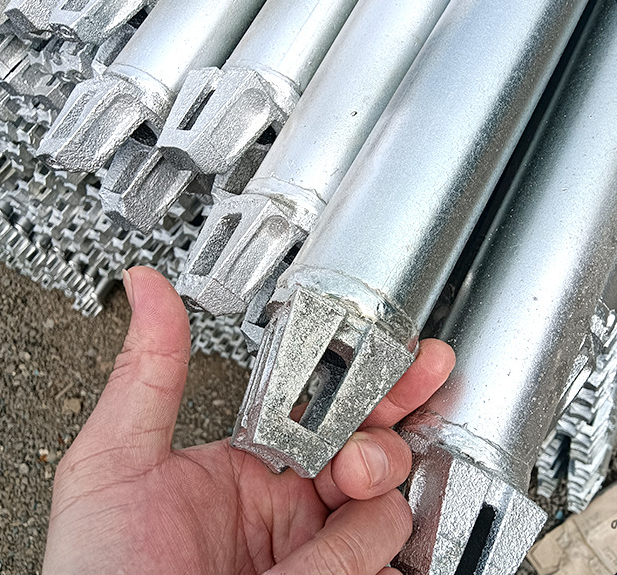
Steel yield strength defines structural performance. Many manufacturers use standard Q235 carbon steel for basic scaffolding. Q235 works fine for light duties and simple access platforms. However, high-load environments demand high-tensile Q345 or Q355 steel. High-tensile steel resists deformation effectively. It prevents the tube from buckling under severe axial loads. You must demand this higher grade for heavy civil engineering projects.
Wall thickness and tube diameter also matter heavily in load-bearing calculations. Standard façade tubes typically use a 48.3mm outside diameter. Heavy shoring towers often utilize 60.3mm tubes for extra rigidity. You should look for minimum wall thicknesses between 3.2mm and 4.0mm. Thinner walls buckle quickly under side-loading or heavy vertical compression. Micro-variations in wall thickness can compromise an entire support leg.
Surface treatment determines component longevity and safety. Hot-dip galvanization is essential for high-load systems. Paint and electro-galvanizing only offer temporary surface protection. Hot-dip galvanization requires a minimum thickness of 80 microns. It permanently coats both the inside and outside of the tube. This prevents invisible internal rusting. Internal rust weakens the tube from the inside out, creating a massive safety hazard.
| Steel Grade | Yield Strength (MPa) | Application Suitability | Risk of Buckling (High Load) |
|---|---|---|---|
| Q235 | 235 | Light access, standard facade painting | High |
| Q345 / Q355 | 345 - 355 | Bridge shoring, heavy falsework pouring | Low |
The connection points determine tower rigidity. The rosette acts as the critical load-transfer junction. Manufacturers weld rosettes to the vertical tube precisely every 500mm. Automatic machine welding provides uniform penetration and consistent load distribution. Manual welding often leaves weak points or uneven beads. These weak spots can snap under shear stress, causing rapid structural collapse.
Security relies on precision mechanics. A Ringlock ledger features a cast steel end mechanism. This end slides directly over the rosette. A wedge pin drops through the engineered opening. Workers hammer the pin down to lock the horizontal brace into the vertical tube. This locks the entire node tightly together, preventing lateral movement.
Tolerance dictates system rigidity. Engineers demand a "zero-wobble" fit for high-load towers. High-quality manufacturing ensures the wedge fits perfectly against the rosette. A tight connection transfers shear forces safely down the tower structure. Loose connections allow micro-movements. This movement multiplies under load and causes dangerous sway during concrete pours or heavy winds.
Trust requires verifiable evidence. Industry standards provide essential evaluation lenses for procurement teams. You must map components against recognized frameworks like EN 12810/12811, ANSI/ASSP A10.8, and specific OSHA guidelines. These frameworks establish baseline safety requirements for structural testing. They dictate how scaffolding should behave under extreme compression.
Evidence-oriented quality assurance separates genuine manufacturers from risky suppliers. You need a strict checklist to verify vendor claims before purchasing. Require the following documents:
You must watch out for specific red flags in the industry. Never rely solely on generic ISO 9001 certificates. ISO 9001 proves a company has basic management processes. It does not prove the scaffolding can hold 50 kilonewtons of downward force. You need product-specific testing data to ensure worker safety.
Common Mistakes: Accepting internal factory testing reports without requiring independent third-party verification documents.
Smart procurement looks far beyond the initial unit price. You must focus on component longevity, structural compatibility, and reducing long-term maintenance. High-quality parts reduce the need for constant safety inspections. They eliminate frequent replacement cycles caused by rust or bent tubes. Investing in premium steel grades keeps civil projects moving safely and efficiently.
Batch consistency poses a major risk during large volume orders. Cheap suppliers often use worn-out stamping tooling. This causes microscopic dimensional variations across a massive order. Even a two-millimeter deviation in a rosette stops components from fitting together on site. You must prioritize manufacturers who maintain strict tooling precision and regular machinery calibration.
Shortlisting logic requires careful vendor analysis. Select vendors who provide clear, mathematically sound load tables. They should offer transparent logistics and verifiable engineering support. If a vendor cannot supply a detailed engineering chart for their specific components, walk away immediately. Reputable suppliers always back their steel with data.
Take specific next-step actions before finalizing any major contract. We recommend taking a methodical approach to verification.
Best Practices: Always test the fit of a sample Ringlock standard with your existing inventory to ensure seamless field integration.
Selecting the right structural components demands rigorous evaluation at every step. You must strictly verify the steel grade, galvanization depth, and rosette node precision. Always demand concrete evidence of compliance through independent third-party testing. The vertical standard acts as the critical backbone of your entire scaffolding system. Compromising on this single component jeopardizes the entire structure, putting lives and expensive projects at severe risk. We strongly encourage decision-makers to audit their current vendor's testing reports today. Consult a qualified structural engineer using the evaluation criteria discussed above to guarantee maximum site safety.
A: Vertical standards come in modular lengths designed for flexible construction. Common lengths include 0.5m, 1.0m, 1.5m, 2.0m, and 3.0m. Manufacturers weld rosettes exactly every 500mm along the tube. This consistent 500mm spacing allows contractors to place horizontal supports at precise intervals, adapting easily to different elevation requirements.
A: Safe working loads vary significantly based on configuration. There is no single maximum number. A 60.3mm heavy-duty tube holds substantially more than a standard 48.3mm tube. Capacity drops as the unbraced length increases. Always refer to manufacturer engineering tables to determine exact capacities for your specific node spacing.
A: No. They are entirely incompatible. Ringlock uses a rosette and wedge-pin mechanism. Cuplock relies on sliding top and bottom cups to secure horizontals. Mixing these components forces improper node connections. This creates extreme structural instability. You must never attempt dangerous field modifications to combine different modular systems.
A: The ledger-to-standard node creates essential 90-degree rigidity. A secure wedge connection prevents the vertical standard from bending or buckling. It transfers lateral wind loads and massive vertical compression forces safely throughout the tower. A loose connection compromises the entire load path, leading to severe structural sway.

