


Tel: +86-131-8042-1118
E-mail:
E-mail:
26 Huanghai Road, Leting Economic Development Zone, Hebei Province, China


Views: 0 Author: Site Editor Publish Time: 2026-07-29 Origin: Site


Construction teams face intense pressure to hit aggressive project deadlines while maintaining strict site safety standards. Traditional tube-and-clamp setups drag down progress on the job site. They require massive labor hours to measure, level, and tighten individual couplers. Frame scaffolds fail when you encounter complex facades or irregular industrial structures, leaving crews with unpredictable load capacities and massive inefficiencies. Manual adjustments slow down every phase of the build and increase the margin for human error.
Upgrading to system scaffolding solves these operational bottlenecks. Engineered for rapid deployment and high structural integrity, modular systems remove the guesswork from temporary access construction. This technical evaluation covers the core characteristics of modular setups. Site engineers, safety directors, and project managers can use this data to determine if upgrading your access equipment aligns with your specific structural demands and site logistics.
Defining the baseline engineering principles separates modular systems from legacy scaffolding methods. Traditional setups rely entirely on friction and the erector's skill to maintain level platforms. Modular systems remove this variability through precision engineering and standardized connection points. You get a structure that builds itself correctly if you follow the node points.
Modular systems utilize a strictly prefabricated design. Verticals, horizontals, and diagonals arrive on-site cut to exact, standardized lengths. These fixed dimensions eliminate the need for manual measuring, cutting, or leveling adjustments on every single tier. Workers simply slot the components together. The system dictates the geometry, ensuring that bays remain perfectly square and platforms remain perfectly level across massive elevations. This standardization means your crew spends time building rather than measuring.
The mechanical properties of the tubing determine the overall capacity of the scaffold. Manufacturers construct these systems using heavy-duty, high-tensile steel grades like Q235 or Q345. This high-yield steel resists deformation under heavy industrial loads. Structural specifications remain uniform across the industry. A standard outer diameter of 48.3mm combined with wall thickness configurations of 3.2mm or 4.0mm guarantees consistent structural engineering math. This uniformity allows engineers to calculate leg loads and wind resistance with absolute certainty.
The most distinct mechanical advantage of modular access is its multi-directional capability. Horizontal members can be set in a nearly 360-degree fashion around the vertical posts. This characteristic enables crews to build scaffolding around complex geometries that defeat standard frame scaffolds. Applications include wrapping cylindrical storage tanks, navigating curved architectural facades, and providing access to angular industrial equipment in tight refinery units. You can follow the exact contour of the structure without creating dangerous gaps.
A scaffold is only as stable as its foundation. Modular systems accommodate various ground conditions through engineered base components. You must establish a solid footing before building vertical.
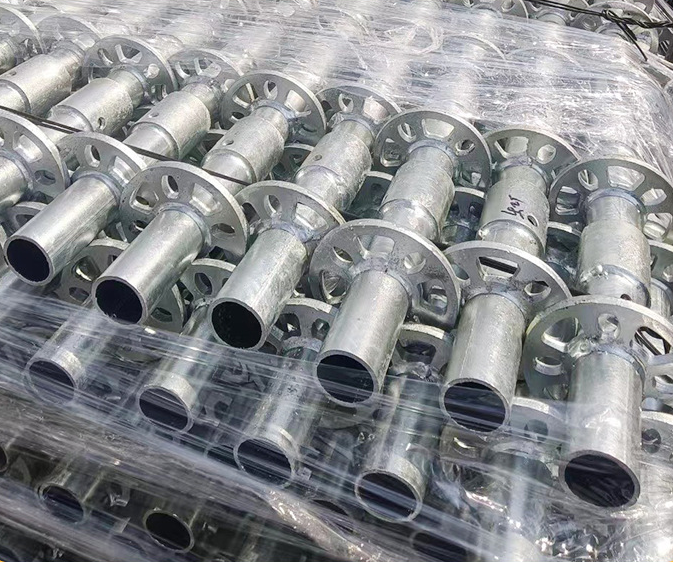
Analyzing an industry-standard modular system helps clarify how these components function together under load. The Ringlock Scaffolding System represents the current benchmark for heavy-duty access and shoring applications across global job sites.
The Ringlock Standard serves as the primary vertical load-bearing tube. These standards feature heavy-duty welded rosettes spaced at regular 500mm intervals along the tube. Each rosette contains eight punched holes. Four small holes accommodate right-angle ledger connections, and four larger holes allow for variable-angle diagonal braces. Material specifications demand hot-dip galvanized steel. This zinc coating prevents internal and external corrosion, ensuring the standard will not buckle under high axial loads over years of harsh exposure.
Ledgers act as the horizontal members that form the guardrails and platform supports. They feature cast-steel ends with captive wedges. The erector slides the ledger head over the rosette and drops the wedge into the designated hole. Diagonal braces provide the critical lateral stability. They connect between rosettes on different elevations, creating rigid, sway-free bays. This entirely eliminates the need for loose clamp fittings and scaffold tubes to brace the structure, speeding up the erection sequence.
The hammer-strike wedge lock system defines the structural rigidity of this setup. Once the wedge drops into the rosette, a worker strikes it with a scaffold hammer. This metal-to-metal connection creates a highly rigid node. The wedge taper pulls the ledger head tight against the vertical standard. This friction and mechanical lock distribute lateral and vertical forces evenly across the structure, preventing joint slippage and minimizing vibration transmission during heavy work.
Benchmarking modular setups against traditional tube-and-clamp and welded frame scaffolding highlights significant operational differences on the job site. You need to understand where each system excels and fails.
Modular systems drastically reduce the labor hours required per cubic meter of scaffolding. Tube-and-clamp requires workers to measure, level, and manually tighten two nuts on every single coupler. Frame scaffolding is fast but only works on straight, level runs. Modular systems eliminate loose fittings. The captive wedges and fixed node points accelerate the erection process, allowing teams to build faster and strip down quicker, turning over the work area to other trades.
Welded frame scaffolding is rigid and linear. It cannot easily turn corners or wrap around obstacles without cumbersome modifications. Modular systems offer multi-directional capabilities. The rosette nodes allow ledgers to branch off at various angles. This makes modular access the mandatory choice for complex environments like chemical refineries, offshore oil rigs, and historic building restorations with intricate masonry.
Modular components can be engineered into highly diverse configurations using the exact same inventory of parts. Teams can build standard independent tied scaffolds, heavy-duty shoring towers, cantilevered drop scaffolds, massive birdcage access platforms, and suspended scaffolds. This versatility means a single inventory system adapts to almost any access challenge you encounter on site.
Logistics heavily impact site efficiency. Managing traditional scaffolding means sorting varied lengths of loose tubes, hundreds of separate right-angle clamps, and swivel couplers. System components are highly standardized. Ledgers, standards, and braces stack neatly into steel pallets. This palletization streamlines transport, minimizes truck space, and simplifies inventory management in the laydown yard.
| Evaluation Dimension | System Scaffolding | Tube & Clamp | Welded Frame |
|---|---|---|---|
| Assembly Speed | Very Fast | Slow | Fast (Linear only) |
| Geometry Adaptability | High (360-degree nodes) | Very High | Low |
| Component Standardization | High (Fixed lengths) | Low (Cut to fit) | Medium |
| Load Predictability | High (Engineered nodes) | Variable (Friction-based) | Medium |
| Loose Parts to Manage | Minimal (Captive wedges) | High (Loose couplers) | Medium (Cross brace pins) |
Addressing safety realities and potential failure points is the primary responsibility of any site manager. Modular systems incorporate engineering features that actively mitigate common job site risks and prevent catastrophic collapses.
The fixed-node design inherently forces the scaffold to be built square and plumb. Because the lengths are fixed, a bay cannot easily be built out of square. This reduces reliance on the erector's subjective judgment and manual tape measuring. Furthermore, the wedge-lock system offers a distinct visual inspection advantage. A safety inspector walking the deck can perform a quick visual check to confirm if a wedge is driven home completely. Loose couplers on traditional scaffolds require physical wrench checks on every single fitting.
Standardized components allow for highly accurate structural engineering calculations. Because the material grades, wall thicknesses, and node locations are exact, engineers can use software modeling tools to simulate loads. This predictability ensures that the scaffold will perform exactly as designed under heavy industrial loads, wind shear, or seismic activity. You know exactly what the structure can hold before the first piece of material is loaded onto the deck.
Despite its engineered safety, you must use modular systems correctly. Site managers must strictly avoid mixing components from different manufacturers. Even if parts look similar, spigot tolerances and wedge tapers vary. Mixing brands creates severe compatibility issues, point loading risks, and voids manufacturer liability. Crews must never fail to properly secure base jacks or caster wheels on unstable or uneven ground. Finally, users must never overload specific bays beyond the manufacturer's engineered specifications, particularly when storing heavy masonry materials on the platform.
Take the following immediate actions to upgrade your site access strategy and improve operational efficiency:
A: System scaffolding features engineered modularity, prefabricated components, and sturdy steel tubing. Its defining feature is the 360-degree horizontal connection capability at fixed node points. It utilizes mechanisms like wedge-locks to ensure rapid, rigid assembly without loose fittings.
A: A Ringlock Standard features heavy-duty welded rosettes spaced at fixed 500mm intervals. These rosettes allow for multi-directional ledger and brace connections. Traditional scaffold tubes are plain pipes that require separate, manually tightened friction clamps to attach any horizontal members.
A: While system scaffolding offers nearly 360-degree flexibility around the vertical post, the members lock into specific engineered angles. Depending on the rosette design, these are typically fixed at 45-degree and 90-degree increments to maintain structural integrity.
A: Frame scaffolding is fast for simple, straight, low-level walls. However, system scaffolding is significantly faster, safer, and more efficient for complex, multi-level, circular, or irregular structures where frame scaffolding would require extensive modifications.
A: Yes. Specialized heavy-duty locking caster wheels can be integrated directly at the base of the vertical standards. This allows crews to construct secure, mobile scaffold tower systems that can be safely rolled across smooth, level surfaces.


